
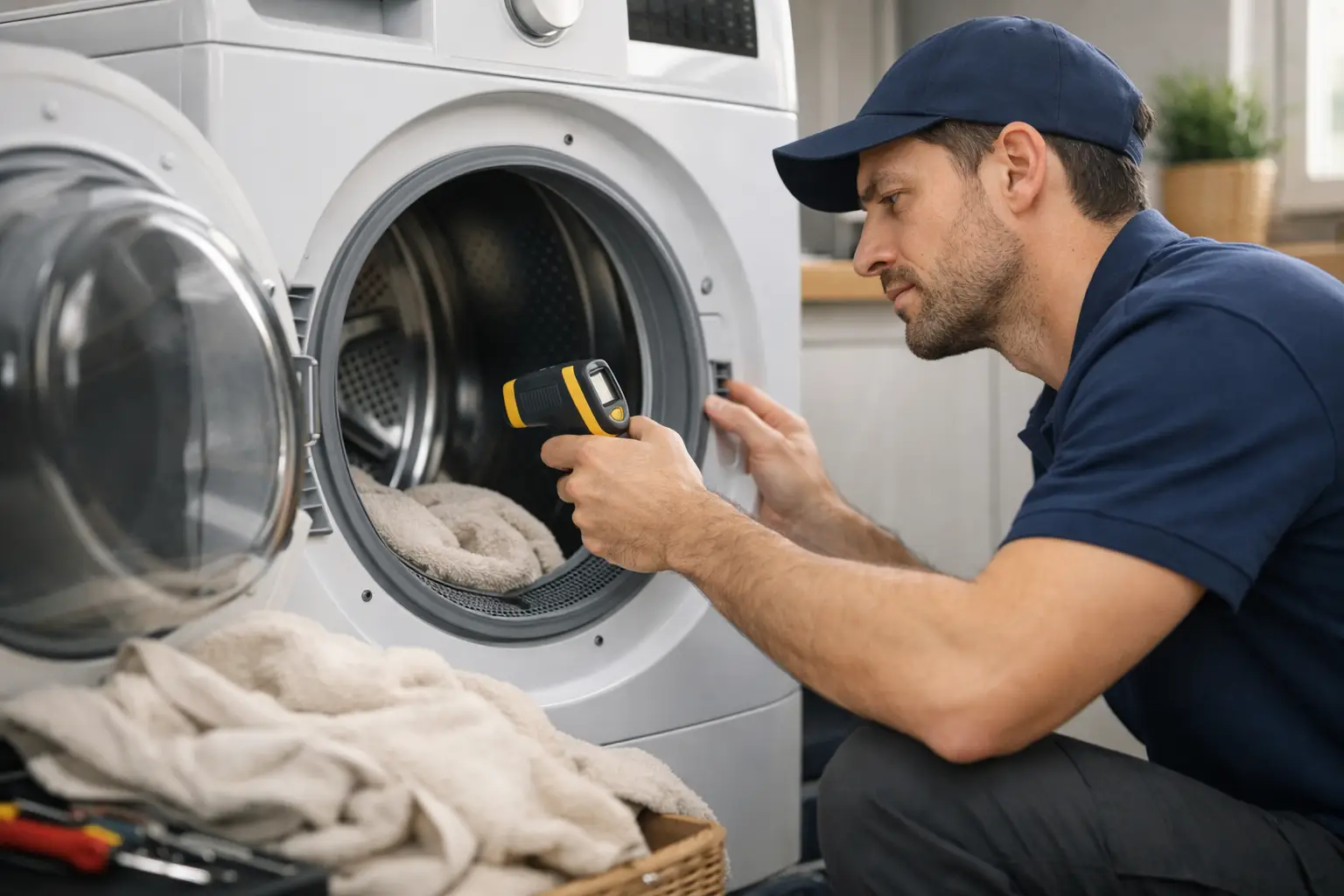
You load the dryer, set the programme, hear the drum turning as normal, then come back to find the clothes still cold and damp. If your tumble dryer not heating issue has appeared without warning, the fault may be simple, or it may point to a failed component that needs proper testing. The key is not to keep running it and hoping for a different result. That usually wastes time, electricity and puts more strain on the appliance.
For most households, a dryer that runs but produces no heat is disruptive straight away. For landlords, managing agents and busy families, it can quickly become a same-day problem. The good news is that some causes are minor and easy to spot. Others need an engineer with the right tools, especially where heaters, thermostats, control boards or electrical supply faults are involved.
Why a tumble dryer is not heating
A tumble dryer needs more than a spinning drum to dry clothes properly. It also needs a working heating circuit, steady airflow and the correct control signals. If one part of that chain fails, the machine may still appear to run normally while producing little or no heat.
Restricted airflow is one of the most common causes. When lint builds up in the filter, condenser housing or venting system, hot air cannot move through the machine as designed. On some models, the appliance then overheats and trips a safety thermostat. On others, performance drops gradually until drying times become excessive and heating becomes inconsistent.
A failed heating element is another likely cause, particularly on vented and condenser dryers. The element can burn out over time, leaving the drum motor and controls working but no usable heat being generated. Heat pump dryers are different. They do not rely on a traditional exposed heater in the same way, so diagnosis can involve sensors, compressor issues or refrigerant system faults.
Thermostats, thermal cut-outs and temperature sensors also play a major role. These components are there to regulate heat and protect the appliance. If one opens, fails or reads incorrectly, the dryer may stop heating altogether. In some cases, the thermostat has tripped because of another problem, not because it is the original fault.
Then there is the power supply. Some tumble dryers can rotate the drum with part power but still fail to heat if there is an issue with the supply, terminal block or internal wiring. That is especially important where there are signs of burning, intermittent operation or tripping electrics.
What you can safely check first
Before assuming the worst, start with the basics. A full lint filter can cause poor drying and overheating. Clean it thoroughly, even if it does not look heavily blocked. If you have a condenser dryer, remove and rinse the condenser unit if the model allows it. If it is a heat pump machine, clean all accessible filters exactly as the manufacturer recommends.
Next, check whether the selected programme should be producing heat. It sounds obvious, but cool-air settings, low-heat cycles and sensor programmes can sometimes be mistaken for a fault, especially if the load type has changed. Also make sure the machine is not overloaded. A packed drum reduces airflow and can make drying seem ineffective.
If your dryer is vented, inspect the hose for kinks, crushing or heavy lint build-up. Poor venting will affect heat performance and can trip safety devices. If the machine is installed in a tight cupboard or utility space, poor ventilation around the unit can also contribute to overheating and shutdown.
Finally, switch the dryer off, unplug it if accessible, and let it stand for a while before restarting. Some machines may temporarily reset after cooling down. If the fault returns straight away, there is usually an underlying issue that needs testing rather than repeated resets.
Signs the fault is more than a simple blockage
If the filter is clean and the settings are correct, pay attention to the pattern of the fault. A dryer that starts cold every time and never heats at all often points to a heater, thermostat, fuse or control problem. A dryer that heats for a few minutes and then goes cold may be overheating because airflow is still restricted or because a sensor is misreading temperatures.
Burning smells, buzzing, visible scorch marks, repeated tripping or a machine that stops mid-cycle all need a more cautious approach. These are not symptoms to ignore. They can indicate electrical damage, failing components or unsafe operation.
It is also worth noting the age and type of the appliance. Older dryers commonly suffer from worn heater assemblies, tired wiring and thermal cut-out issues. Heat pump models are generally more efficient but more complex to diagnose. What looks like a heating fault may actually be a problem with moisture sensing, air circulation or the sealed system.
Tumble dryer not heating after cleaning the filter
If your tumble dryer not heating problem continues even after cleaning the filter and condenser, the blockage may be deeper in the air path. Internal ducts, fan housings and vent routes can collect compacted lint over time. That build-up is not always visible from the outside.
At that stage, proper diagnosis matters more than guesswork. Replacing parts at random often costs more in the long run and can miss the actual cause. A qualified engineer will usually test the heater circuit, thermostats, continuity, sensor readings and power supply before recommending any repair.
This is particularly important if the dryer has previously overheated. A thermostat may have cut out to protect the machine, but unless the reason for the overheating is dealt with, the same issue can happen again after the part is replaced.
When to stop using the appliance
There is a difference between a dryer that is inconvenient and one that may be unsafe. If the machine smells hot, trips the electrics, shows signs of burnt wiring, or has stopped heating after a loud pop or crack, stop using it. The same applies if you notice melting around the plug, socket or connection point.
A tumble dryer draws substantial power when heating. Any weakness in wiring, terminals or components can worsen quickly under load. For households and rental properties, that is not something to delay. Safety comes first, especially where children, tenants or continuous use are involved.
Why professional diagnosis saves time
Dryers can have the same symptom but completely different faults. A Bosch, Hotpoint, Beko, Samsung, LG or Miele machine may all present as “running but not heating”, yet the repair path can vary significantly by design. Some need a heater assembly. Others need thermostats, relays, sensors, a motor capacitor, a control module repair or attention to the power supply.
An experienced engineer does not just swap the obvious part. They test the appliance under the fault condition, inspect for secondary damage and check whether the repair will be durable. That matters if you want a true first-time fix rather than a temporary result.
For London homes, landlords and businesses, speed matters too. When laundry is backing up or a tenancy handover is approaching, you need clear answers quickly. FaultFree Engineering Group approaches these call-outs with the same practical focus as any urgent domestic appliance repair – accurate diagnostics, transparent pricing and safe workmanship from the start.
Repair or replace?
It depends on the age of the dryer, the brand, the fault and the overall condition of the appliance. A blocked system, failed thermostat or standard heating element repair is often worthwhile if the machine is otherwise sound. A heavily worn dryer with multiple faults, control board damage or repeated overheating history may not be the best candidate for further spend.
There is also an efficiency question. Older tumble dryers can be more expensive to run, so if a major repair is needed, replacement may make more sense. On the other hand, many good-quality machines are absolutely worth repairing when the fault is isolated and parts are available.
A proper assessment should give you both options honestly. That is usually what customers want – not a sales push, just the facts, the likely cost and the safest next step.
Preventing the same fault from happening again
Routine cleaning does more than improve drying times. It protects the heater system, improves airflow and reduces strain on thermostats and fans. Clean the lint filter after every cycle, keep condenser components maintained, and make sure vented models can exhaust air freely.
Try not to overload the drum, and avoid running the dryer in a cramped space with poor ventilation. If drying times start creeping up, treat that as an early warning rather than waiting for a full breakdown. Small performance changes often show up before complete heat loss.
For rental properties and high-use households, periodic maintenance is a sensible step. A dryer that is used daily will naturally build up lint and wear more quickly than one used once a week. A little attention early on can prevent a larger repair later.
If your dryer is turning but not drying, the fault may be minor, or it may be the start of a more serious heating or electrical problem. A careful check of filters, airflow and settings is a good place to start. After that, the safest move is straightforward diagnosis from someone who can test it properly and get the machine back into reliable working order.