
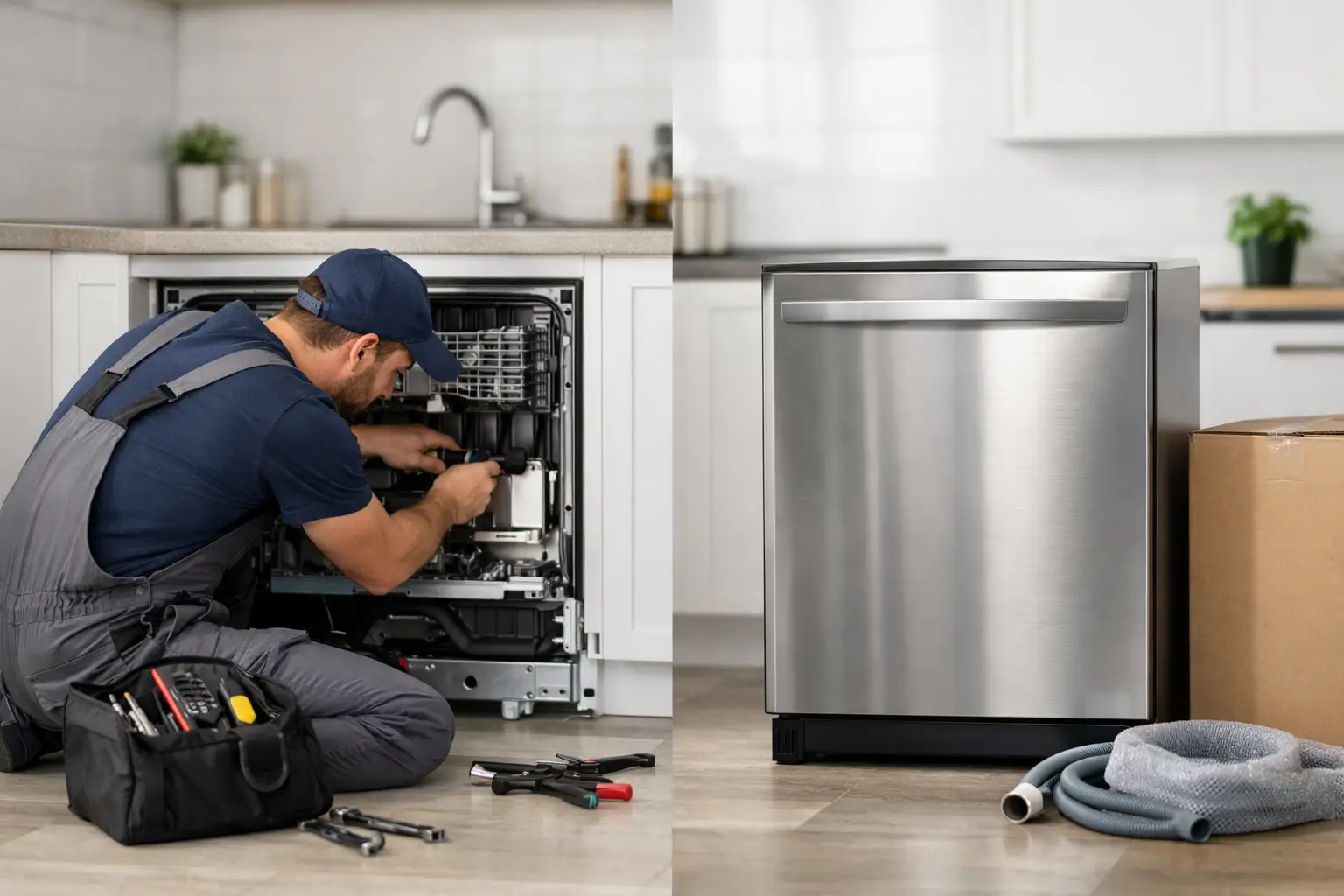
A dishwasher that stops mid-cycle on a Tuesday night tends to force the question fast – should you repair or replace dishwasher faults, or stop spending on a machine that is already on its way out? For most London households, landlords and busy tenants, the right answer comes down to age, fault type, repair cost, and how urgently you need the kitchen back in working order.
The mistake people often make is going straight to the cheapest option in front of them. A quick repair is not always good value if the appliance is already near the end of its service life. Equally, replacing a dishwasher too early can mean spending hundreds when a straightforward part change would have solved the problem properly.
When repair or replace dishwasher is the right question
This is not just about money. It is also about reliability, safety and disruption.
If your dishwasher is tripping the electrics, leaking into kitchen units, failing to heat water, or leaving plates dirty after every wash, you need more than a guess. Some faults are isolated and economical to repair. Others point to wider wear across pumps, heaters, control boards or door seals. In rental properties and busy family homes, repeated breakdowns can create more cost than a clear decision made early.
A proper diagnosis matters because the same symptom can have very different causes. A machine that will not drain may need a simple pump clean-out, or it may have a failing drain pump, wiring issue or control fault. The outcome changes the decision.
Start with the age of the appliance
Dishwasher age is one of the strongest indicators of whether repair is sensible.
As a general guide, a dishwasher under 5 years old is usually worth repairing if the rest of the machine is in good condition. Between 5 and 8 years, it depends on the brand, the fault and how heavily the appliance has been used. Once a dishwasher is past 8 to 10 years, replacement becomes more attractive, especially if the issue involves a major component.
That said, age on its own is not enough. A premium machine from brands such as Miele, Bosch or AEG may justify repair for longer than a lower-cost unit that has already had several faults. Usage matters too. A dishwasher in a family kitchen running daily cycles will age faster than one in a lightly used flat.
Compare repair cost against replacement value
The clearest rule is this: if the repair cost is approaching half the cost of a like-for-like replacement, pause before approving the work.
This does not mean every repair over 50 per cent is automatically poor value. Installation costs, disposal, plumbing adjustments and the hassle of sourcing a replacement all matter. But if an older dishwasher needs an expensive board, motor or heating system, paying heavily for one repair can simply delay the next failure.
On the other hand, a modest repair to a newer machine often makes complete sense. Replacing a pump, inlet valve, latch or door seal is very different from rebuilding the machine around a major electrical or mechanical fault.
For landlords, this calculation should also include downtime. A cheaper but unreliable short-term fix can become more expensive if it leads to repeat callouts, tenant complaints or water damage.
Faults that are usually worth repairing
Some dishwasher problems look serious but are often cost-effective to fix.
Drainage issues are a common example. If the machine is not emptying properly, the cause may be a blocked filter, obstructed hose, jammed pump or faulty drain pump. These are often repairable without the cost of replacing the appliance.
Water intake faults can also be straightforward. A defective inlet valve, float switch problem or pressure issue may stop the dishwasher filling, but these faults are often localised. Door latch failures, worn seals and spray arm issues are also typically repair-friendly.
If the dishwasher is cleaning poorly, do not assume the machine is finished. Build-up, blocked jets, low water temperature, dosing issues and wash pump weakness can all affect performance. A proper inspection usually tells you quickly whether the appliance needs repair or whether it is simply showing broader signs of age.
Faults that push the balance towards replacement
Some jobs deserve a harder look before you invest.
A failed control board can be expensive, particularly if the appliance is older or parts are difficult to source. The same applies to motor failures, heater assembly faults on ageing machines, or multiple faults appearing at once. If the dishwasher leaks because internal components and seals are deteriorating across the machine, that is rarely a good sign.
Rust is another warning. Surface marks on baskets are one thing, but corrosion on the cabinet, base, door frame or internal structure points to decline that repair may not solve for long. Repeated tripping of electrics should also be treated seriously. If a dishwasher has an insulation fault or water ingress affecting electrical components, safety comes first.
A noisy machine can go either way. A single worn pump or fan may be repairable. But grinding, vibration and poor performance together often suggest wider wear.
Reliability matters more than a one-off bill
A dishwasher is not good value just because it can be made to run again. It needs to stay reliable.
This is where history matters. If this is the first fault in years, repair is often a sensible route. If the appliance has already had several breakdowns, replacement may be the more controlled decision. The same applies if different faults keep appearing every few months. That pattern usually means the machine is wearing out overall, not suffering from one isolated issue.
For households with children, shared kitchens, rental properties or small commercial settings, reliability carries a real operational value. Constant disruption, hand washing and repeat engineer visits all add hidden cost.
Energy efficiency is worth considering, but do not overstate it
People often assume a new dishwasher will instantly save enough on bills to justify replacement. Sometimes yes, often not as dramatically as expected.
A newer machine may use less water and electricity, but the numbers only make sense when compared honestly against repair cost and remaining life. If your existing dishwasher can be repaired at a reasonable price and still has several solid years left, replacing it purely for efficiency may not stack up.
Where efficiency becomes more relevant is with very old appliances, especially those with heating problems, poor wash performance or long inefficient cycles. In those cases, replacement can bring a practical improvement alongside lower running costs.
Safety should settle the matter quickly
If there is any smell of burning, visible scorching, repeated power trips, standing water near electrical connections, or signs of overheating, stop using the dishwasher until it has been checked.
This is not the point for trial and error. Dishwashers combine water, heat and electricity in one enclosed appliance. A proper diagnosis is essential, particularly in occupied rental homes and busy family kitchens. Safety-led decisions are usually the right ones, even when they are not the cheapest in the short term.
A simple way to decide
If you are trying to repair or replace dishwasher issues without wasting time, ask four direct questions.
How old is the appliance? What exactly has failed? How much is the repair compared with replacement? Has the machine otherwise been reliable?
If the dishwasher is relatively young, the fault is isolated, and the repair is proportionate, repair is normally the sensible option. If the machine is old, unreliable, and facing a major component failure, replacement is usually the better investment.
This is why many customers prefer a service-led approach rather than guesswork. An accurate diagnosis gives you the information to make a clean decision, instead of paying for hope. At FaultFree Engineering Group, that is exactly how we approach it – clear fault finding, transparent pricing and straightforward advice based on what will last.
The best decision is the one that holds up in six months
The real test is not whether you can get the dishwasher running today. It is whether you will feel the decision was sound after months of normal use.
Sometimes a well-timed repair gives you years more service and saves significant cost. Sometimes replacement stops a cycle of disruption before it becomes more expensive than the appliance is worth. If you base the choice on age, fault type, repair value and safety, you are far more likely to get it right the first time.