
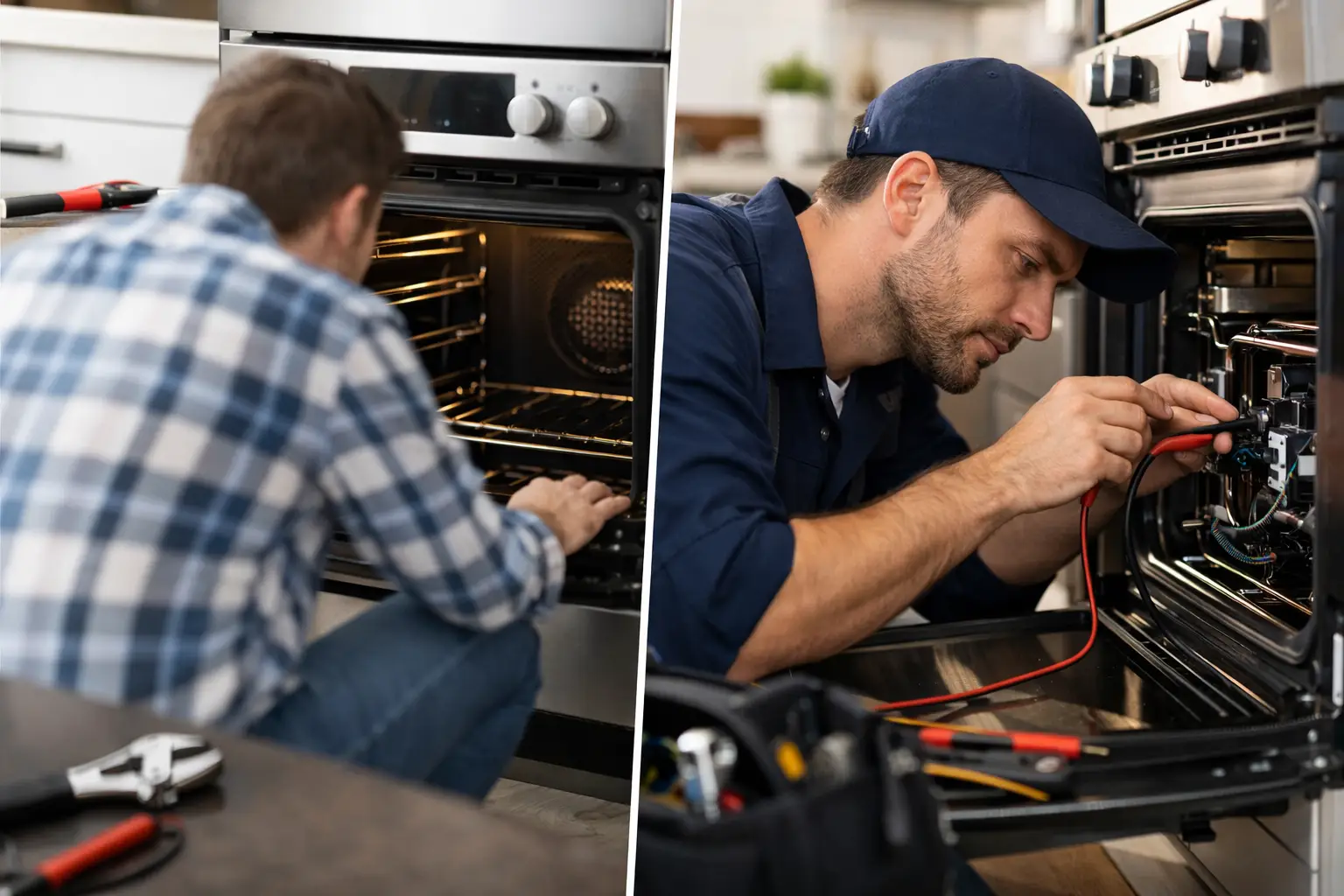
Sunday lunch is half prepared, the oven is on, and nothing is happening except a faint click and a growing sense that the day has just become more complicated. That is usually when oven repair stops being a task people mean to sort out later and becomes urgent. For homeowners, tenants and landlords, a faulty oven is not just inconvenient. It affects routines, tenants, bookings, and in some cases safety.
A good repair starts with a simple question: is this a minor fault, or a sign of a bigger electrical or appliance issue? The right answer saves time, avoids wasted money, and reduces the risk of turning a repairable problem into a full replacement.
Common oven repair faults and what they usually mean
Most ovens do not fail without warning. They tend to show a pattern first. Maybe cooking times suddenly get longer. Maybe the grill still works but the main oven does not. Maybe the fan is noisy, the temperature is uneven, or the appliance keeps tripping the electrics.
If the oven is not heating up at all, the cause could be a failed heating element, a faulty thermostat, a worn selector switch, or an issue with the power supply. In fan ovens, one of the most common faults is an element failure. The fan may still run, which makes it look as though the appliance is working, but no real heat is being produced.
When an oven heats, but not to the right temperature, the problem is often with the thermostat, sensor, or control system. This can be frustrating because the fault is less obvious. Food cooks unevenly, dishes take longer than expected, and customers often only realise there is an issue after several failed meals.
If the oven keeps tripping the fuse board, that needs treating more seriously. A damaged element, insulation breakdown, wiring fault or moisture-related issue can all cause repeated tripping. This is not one to ignore and hope for the best. The same applies if there is a burning smell, visible sparking, or signs of heat damage around the controls.
Then there are door-related problems. A door that does not close properly can lead to heat loss, poor cooking performance and strain on internal parts. Hinges, seals and latches wear out over time, especially in busy family kitchens and rental properties where appliances get heavy use.
What you can safely check before booking oven repair
There are a few sensible checks worth doing before arranging a visit. Start with the basics. Confirm the appliance has power, check whether the clock or timer has been reset, and make sure the oven is not stuck in automatic mode. It is a surprisingly common issue after a power cut or when controls have been knocked.
If one function works and another does not, that is useful information. For example, if the grill heats but the oven does not, that points more towards a specific component fault than a total power failure. If the internal light works but there is no heat, that also helps narrow the diagnosis.
Take note of any error codes, unusual noises, burning smells or tripping patterns. If the appliance trips only when heating begins, that matters. If the fan runs continuously or sounds rough, that matters too. Clear details help an engineer get to the likely cause faster and improve the chance of a first-time fix.
What you should not do is start dismantling panels, testing live parts or replacing elements without the right tools and qualifications. Ovens combine high heat with mains electricity. Even after isolation, components can present risks if handled incorrectly.
When oven repair becomes a safety issue
Some oven faults are mostly about performance. Others are about safety from the start. Repeated electrical tripping, exposed wiring, scorch marks, smoke, or any sign that the appliance is overheating should be treated as urgent.
Landlords and property managers need to be especially careful here. A tenant reporting a cooker fault is not just raising a comfort issue. If the fault involves electrics, unreliable operation, or possible overheating, there may be a duty to act quickly to keep the property safe and operational.
Older appliances can also develop faults that sit between appliance repair and wider electrical testing. An oven may appear to be the problem, but the root cause can be the circuit, connection point, isolation switch or surrounding wiring. That is where having an engineering team with both appliance and electrical expertise makes a real difference. It avoids the usual back-and-forth of one contractor blaming the appliance and another blaming the installation.
Repair or replace – what actually makes sense?
Not every faulty oven should be repaired, but replacement is not automatically the smarter option either. The right choice depends on age, brand, fault type, parts availability and overall condition.
If the issue is a heating element, thermostat, fan motor, door seal or switch assembly, repair is often the sensible route. These are common faults on many major brands, and a proper repair can return the appliance to reliable working order without the cost and disruption of replacement.
If the oven is much older, has multiple faults, or parts are obsolete, replacement may offer better value. The same applies where there is major internal damage, repeated breakdown history, or signs of wider wear that suggest more repairs are likely to follow. A cheap repair is not good value if it only buys a few more weeks.
For landlords, the calculation is usually practical. Downtime matters. Tenant disruption matters. Cost certainty matters. A clear diagnosis with transparent pricing helps decide whether to proceed with repair or replace the unit before another tenancy issue develops.
Why accurate diagnosis matters in oven repair
A lot of frustration in this trade comes from guesswork. Replacing one part because it is a common fault can work, but it can also waste time and money if the real issue sits elsewhere.
Take an oven that does not heat properly. It might be the element, but it could also be the thermostat, the control board, the selector switch, the wiring to the element, or even a fault in the power supply. Symptoms overlap. That is why tested diagnosis matters more than assumptions.
A proper engineer will inspect, test and confirm the cause before recommending repair. That approach is better for safety, better for cost control, and better for long-term reliability. It is also how first-time fix performance improves. The right part fitted to the right fault is what gets kitchens working again quickly.
Oven repair for busy London households and rental properties
In London, appliance breakdowns rarely happen at a convenient moment. They affect working households, shared homes, managed properties and commercial kitchens that need quick turnaround and clear communication. Waiting days just to find out whether the oven is repairable is not much use to anyone.
This is where service response matters just as much as technical skill. Same-day or next-day availability, honest advice, and engineers who arrive prepared to diagnose and complete the work properly make the difference between a manageable interruption and a drawn-out problem.
FaultFree Engineering Group Ltd works with exactly that in mind – practical support, transparent pricing, and safe, durable repairs for domestic appliances across London. For customers, that means less chasing, less uncertainty and a clearer route back to normal use.
How to help your oven last longer after repair
Once the fault is fixed, a bit of care goes a long way. Avoid slamming the door, keep seals clean, and do not ignore early warning signs such as uneven heating or longer cooking times. Grease build-up can also affect performance and, in some cases, increase the risk of smoking and overheating.
It is also worth being realistic about wear. A heavily used oven in a family home or rental property will need more attention than a lightly used appliance. Regular use is normal. Delaying small repairs until they become bigger ones is what usually turns a straightforward job into a more expensive callout.
The best approach is simple: if the oven starts behaving differently, do not wait for it to fail completely. A fast, accurate assessment often means a safer repair, a lower bill, and far less disruption. When cooking, tenancy obligations or day-to-day routines depend on that appliance, getting the right engineer involved early is usually the most practical decision you can make.