
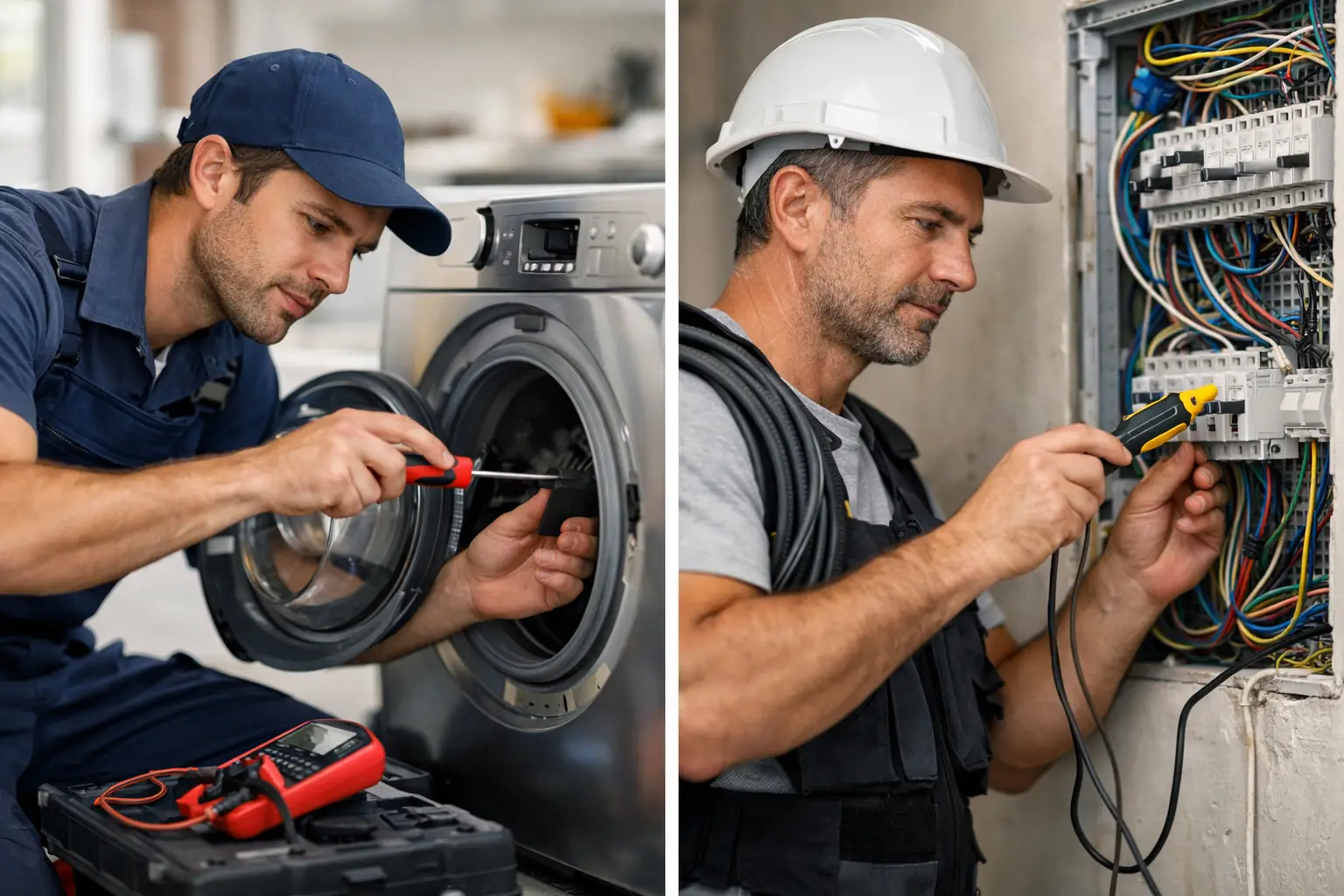
When the oven stops heating or the washing machine keeps tripping the electrics, most people ask the same question: appliance engineer vs electrician – who do you actually need? Get that choice right and the fault is diagnosed faster, the repair is safer, and you avoid paying for the wrong trade to attend first.
For London households, landlords and businesses, the confusion is understandable. Modern appliances sit right on the line between mechanical systems, electronic controls and your property’s electrical installation. Some faults are clearly inside the appliance. Others are caused by the circuit, connection, fuse spur, isolator, earthing or load on the supply. That is why knowing the difference matters.
Appliance engineer vs electrician: what is the difference?
An appliance engineer works on the appliance itself. That includes diagnosing and repairing faults in washing machines, ovens, cookers, tumble dryers, dishwashers, fridge freezers, microwaves, extractor hoods and electric hobs. Their work usually focuses on components such as heating elements, thermostats, door locks, pumps, motors, belts, control boards, sensors, fans and internal wiring within the unit.
An electrician works on the property’s electrical system. That includes sockets, cooker points, dedicated circuits, consumer units, RCD trips, fused connection units, isolators, lighting, rewires, fault finding, safety inspections and certification. If the issue is with the fixed wiring or the supply feeding the appliance, that falls into electrical work rather than appliance repair.
In simple terms, if the machine is faulty, you usually need an appliance engineer. If the power supply to the machine is faulty, you usually need an electrician. The difficulty is that symptoms often overlap.
A cooker that keeps cutting out may have a failed internal thermostat, but it could also be suffering from a loose connection at the cooker outlet plate. A dishwasher that appears dead might have a failed control module, but it could just as easily have lost supply from a switched spur. A tumble dryer that trips the electrics could have an internal earth fault, or the circuit protection could be undersized or already unstable.
When you need an appliance engineer
If the appliance powers on but does not work properly, an appliance engineer is normally the right first call. That includes cases where the washing machine fills but does not spin, the oven fan runs but there is no heat, the fridge is on but not cooling, or the dishwasher starts and then stops mid-cycle.
These are appliance performance faults. The supply may be present and the property electrics may be fine. The problem is more likely to be inside the unit, where specialist appliance diagnostics are needed.
An appliance engineer is also the right choice for replacement parts, brand-specific fault codes and issues linked to wear and tear. A burnt-out element, broken door interlock, failed pump, defective PCB or damaged sensor will not be resolved by general electrical work alone.
Installation can also fall under appliance engineering, depending on the appliance. Freestanding washing machines, dishwashers, electric ovens, hobs and extractor hoods often need someone who understands both fitting requirements and safe functional testing. What matters is not just connecting it, but making sure it operates correctly under load and matches the manufacturer’s requirements.
When you need an electrician
If there is no power getting to the appliance, or the wider electrical system is showing signs of trouble, call an electrician. This is especially true if sockets have failed, breakers are tripping repeatedly, lights flicker when the appliance starts, there is burning damage at a connection point, or the fault appears to affect more than one item.
Electricians deal with the building infrastructure behind the appliance. They test circuits, verify earthing and bonding, inspect connections, check protective devices and identify whether the issue is with the fixed installation rather than the appliance itself.
This is the right route for new cooker circuits, consumer unit upgrades, isolation switches, rewiring, EICRs, landlord certificates and electrical fault finding that goes beyond one machine. If a built-in oven cannot be installed because the cable size is wrong, the protective device is unsuitable or the circuit is non-compliant, that is electrician territory.
Safety comes first here. Signs such as scorching, buzzing at switches, persistent tripping, electric shocks from metalwork or damaged cable insulation should never be treated as a simple appliance issue until the installation has been checked.
The grey area: when it could be either
This is where many callouts go wrong. Some faults sit between the appliance and the property electrics, and that is where experience matters.
Take an electric cooker that trips the RCD after ten minutes of use. It may be an internal heating element leaking to earth as it warms up. It may also be a supply issue, moisture ingress at a connection point or a fault elsewhere on the same circuit that only shows under load. A standard visual check will not settle that.
Or consider a washing machine that appears completely dead. If the socket is live, an appliance engineer is likely to find the fault quickly. If the socket is not live, the appliance may be perfectly serviceable and an electrician is needed instead. Sending the wrong trade first can delay the repair and add cost.
This is one reason a combined service model works well in practice. When appliance and electrical expertise sit under one roof, there is less guesswork, fewer handovers and a much better chance of identifying the fault on the first visit.
Common examples and who to call
If your oven is not heating but the clock and light still work, start with an appliance engineer. If your oven has no power at all and the cooker switch or breaker is also affected, start with an electrician.
If your washing machine trips the power when a cycle begins, it could be either, but an engineer with electrical fault-finding capability is ideal. If your tumble dryer runs but produces no heat, that is usually an appliance repair issue. If your extractor hood installation requires a new spur or altered wiring, that is electrical work.
If a landlord needs an EICR, consumer unit upgrade or remedial work after inspection, call an electrician. If a tenant reports that the fridge freezer is running but not cooling, call an appliance engineer. If an electric hob is being replaced and the existing supply needs checking for suitability, both skill sets may be relevant.
Why the wrong callout costs time
For busy households and rental properties, delay is often the real problem. A dead cooker or failed fridge freezer is disruptive enough without booking one specialist only to be told you need another.
There is also a cost angle. If the issue turns out to be outside the attending engineer’s scope, you may still pay for diagnostic time and then need a second appointment. For landlords, that means longer void risk, unhappy tenants or a property that remains partly unserviceable. For businesses, it can affect staff facilities or trading continuity.
A practical provider will be honest about where the fault sits. That means no guessing, no vague promises and no trying to force an electrical issue into an appliance repair booking, or the other way round.
What to tell the engineer before you book
A clear description helps direct the job to the right person. Say whether the appliance has any power, whether other sockets or lights are affected, whether the consumer unit has tripped, whether there is a burning smell, and whether the issue started suddenly or has been getting worse.
If you can, note the make and model, any error code, and what happens just before the fault appears. Does the oven fail only when heating? Does the dishwasher lose power mid-cycle? Does the hob trip the supply only on one ring? Those details matter because they point towards either internal component failure or supply-side faults.
Photos can help as well, especially if there is visible damage to a plug, switch, outlet plate or cable. The more precise the information, the faster the job can be routed correctly.
Choosing the right service for London properties
In London, many properties have a mix of older wiring, upgraded kitchens, built-in appliances and heavily used rental stock. That creates more overlap between appliance issues and electrical faults than people expect. A new appliance fitted onto an old supply, or an ageing cooker on a stressed circuit, is a common example.
That is why many customers now prefer one provider that can handle appliance repair, installation and electrical work without passing the problem elsewhere. FaultFree Engineering Group operates in exactly that space, supporting homes, landlords and businesses with practical diagnostics, transparent pricing and safety-led workmanship.
The best choice is not about titles alone. It is about getting someone who can identify whether the fault is inside the appliance, within the electrical installation, or across both. When you book with that in mind, you save time, reduce repeat visits and get the kind of fix that lasts.
If you are unsure who to call, start with the symptoms, not the job title. A good engineer will do the same.