
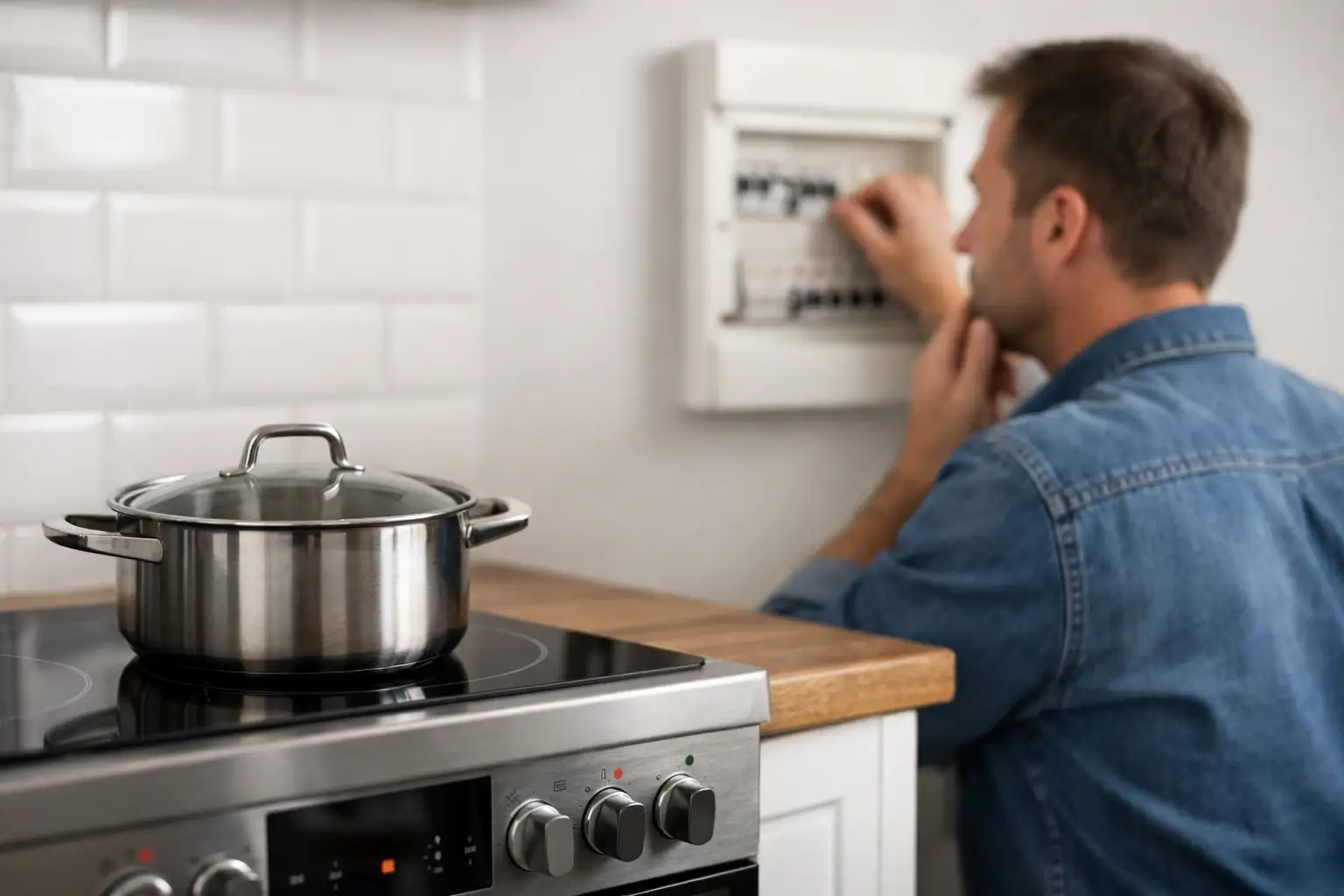
You switch the cooker on, the power goes off, and dinner stops before it starts. If you are asking, why is my cooker tripping, the short answer is that something in the appliance or the circuit is causing an electrical fault that your safety devices are correctly reacting to.
That matters because a tripping cooker is not just inconvenient. It can point to a failing element, damaged wiring, moisture inside a component, or a problem with the cooker circuit itself. Some faults are contained within the appliance. Others sit with the connection point, isolator switch, consumer unit, or the supply to the property. The key is not guessing. It is working through the fault safely and ruling out what can and cannot be used.
Why is my cooker tripping when I turn it on?
The most common reason is a faulty heating element. In electric cookers and ovens, grill elements, fan oven elements and hob elements can break down over time. When the insulation inside an element fails, current can leak to earth. The RCD or RCBO detects that leakage and trips the supply to protect you.
A thermostat, selector switch, internal wiring loom or cooling fan can also be responsible. If the cooker trips as soon as you turn the isolator on, the fault may be more serious and present before any heating starts. If it trips only when a specific function is selected, such as grill or fan oven, that narrows the fault down considerably.
The timing matters. A cooker that trips instantly often points to a direct short or earth fault. A cooker that runs for five or ten minutes before tripping may have a component that only fails once it heats up. That distinction helps an engineer test the right parts first and avoid unnecessary replacement.
What the type of trip can tell you
Not all trips mean the same thing. If the RCD trips, the issue is often earth leakage. If the MCB trips, the problem may be overload or a short circuit. If the main switch goes, the fault may be broader or linked to the arrangement of the consumer unit.
For a householder, the practical takeaway is simple. Check what has actually switched off. If only the cooker breaker has gone, the fault may be local to that circuit. If half the property has lost power on an RCD-protected side, the cooker may be leaking current to earth. That is useful information when booking a repair, because it helps separate an appliance fault from a wider electrical issue.
The most common cooker faults behind tripping
Heating elements are still top of the list, especially in older ovens. They work hard, they get hot, and they do eventually fail. A fan oven element may show visible blistering or splitting, but not always. Quite often the damage is internal and only appears under test.
Damaged internal wiring is another common cause. Heat, grease and age all take their toll. If insulation becomes brittle or a wire has rubbed against the metal casing, the cooker can trip unpredictably.
Switches and control boards can fail too. On some models the selector switch burns out or carbon tracking develops. On others, a relay on the control board sticks or shorts. With ceramic hobs and cooker tops, spilled liquid can work its way into components and cause intermittent faults.
Then there is the connection side. Loose terminals at the cooker outlet plate, a tired cooker switch, or signs of overheating at the cable can all cause nuisance tripping or outright failure. This is where appliance repair and electrical fault finding often overlap.
Why is my cooker tripping only one function?
If the cooker trips only on the grill, the grill element is a strong suspect. If it trips only on fan oven mode, the fan element or fan motor may be involved. If a hob ring causes the trip but the oven does not, focus shifts to that ring, its regulator, or associated wiring.
This matters because selective tripping usually means the fault is tied to one load path rather than the whole appliance. That makes diagnosis faster and usually more cost-effective. Replacing parts without testing is rarely the right move, especially on premium brands where components are more expensive.
If the cooker trips on every setting, the fault may be at the supply terminal block, internal mains filter, or the incoming cable to the appliance. In some cases it is not the cooker at all but a weakness on the circuit that only shows up under heavy load.
Safe checks you can do before calling an engineer
Start by stopping use of the cooker until the fault is understood. Repeatedly resetting the breaker and trying again is not a fix. It can worsen damage and increase the risk of burnt wiring or electric shock.
You can check whether the trip happens with one function or all of them, but only if doing so does not involve exposing any wiring and only if the cooker can be used briefly without forcing the breaker back on repeatedly. Make a note of exactly what happens. Does it trip immediately, after preheating, or when a hob ring is turned up? Does the clock stay on? Is there any smell of burning? Those details help speed up diagnosis.
Also look for obvious signs without dismantling anything. Scorching around the cooker switch, a loose faceplate, crackling sounds, or a burnt smell are all reasons to leave the appliance off and book a qualified engineer promptly.
Do not remove covers, pull out built-in appliances if they are hard-wired, or attempt live testing. A cooker circuit is not a plug-in kettle. It is a high-load fixed appliance, and faults need proper testing equipment.
When the problem is not the cooker itself
Sometimes the cooker is blamed because it is the only appliance that uses enough power to reveal an electrical weakness. A loose neutral, a worn breaker, undersized or damaged cable, or heat damage at the connection plate can all trip under load.
This is especially relevant in older properties, rental homes, or kitchens that have been altered over time. If a cooker has recently been installed and starts tripping straight away, the issue may be incorrect connection, damaged supply cable, or an incompatible fault on the existing circuit. New appliance does not always mean no appliance fault, but installation and circuit checks become more important.
This is one reason customers often prefer a company that handles both appliance repairs and electrical fault finding. It saves the back-and-forth between trades and gets to the real cause quicker.
Why moisture can make a cooker trip
Moisture is often overlooked. After deep cleaning, after a spill, or in appliances left unused for a while, damp can sit inside an element or terminal area. When power is applied, leakage to earth can increase enough to trip the RCD.
Sometimes that clears as the component dries. Sometimes it is a sign the part has already deteriorated and will fail again. If tripping started after cleaning or after the property has been empty, that is worth mentioning. It may change the first line of testing.
Is it worth repairing a cooker that keeps tripping?
Usually, yes, if the fault is isolated to a replaceable component such as an element, switch or thermostat. Many cooker repairs are straightforward once the fault is properly identified. The question becomes more balanced if the appliance has multiple faults, severe internal heat damage, obsolete parts, or poor overall condition.
Age matters, but not on its own. A good-quality cooker with a failed grill element is often well worth repairing. A low-cost unit with wiring damage, failing controls and repeated trip faults may not be. A proper diagnosis gives you a clear repair-versus-replace decision rather than guesswork.
When to call for professional help
If the cooker trips more than once, trips instantly, gives off a burning smell, or takes out part of the property supply, stop using it and arrange testing. The same applies if the cooker switch feels warm, the cable connection looks discoloured, or the appliance was recently fitted and has never worked properly.
For landlords and managing agents, this is not a fault to leave until convenient. A tripping cooker can quickly turn into a safety issue, tenant complaint, or avoidable callout outside working hours. Getting it diagnosed early usually saves time and money.
At FaultFree Engineering Group, this kind of job is approached in a practical way. The aim is to identify whether the fault sits in the appliance, the connection, or the cooker circuit, then give a clear next step with transparent pricing and no guesswork.
If your cooker keeps tripping, treat the trip as the warning it is meant to be. The safety device is doing its job. The next step is making sure the fault is found properly, repaired safely, and not left to become a bigger problem.