
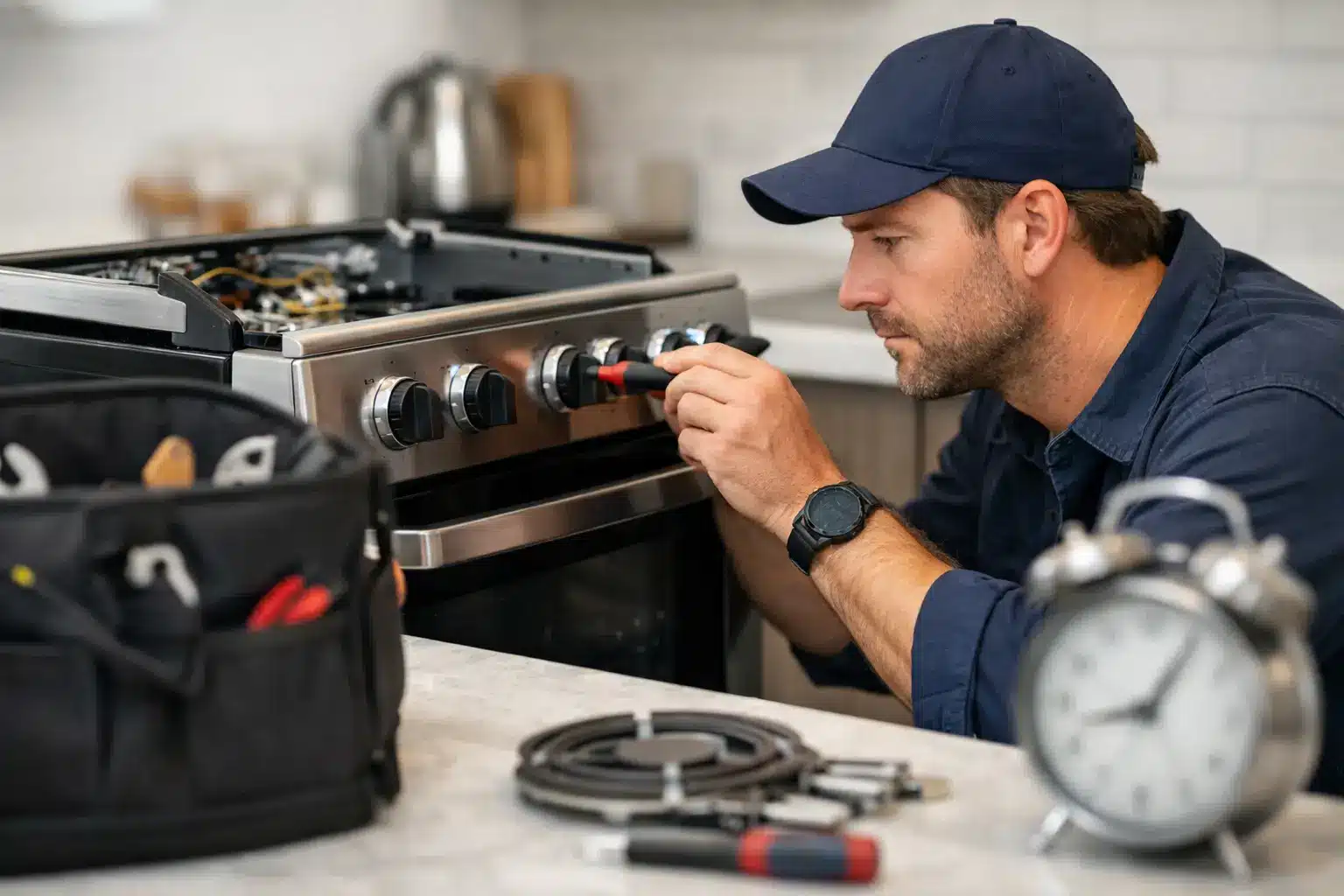
A cooker failure rarely arrives at a convenient time. One minute dinner is on the hob; the next, the oven will not heat, the display is dead, or a burner will not ignite. The cooker repair timeframe depends on the fault, the appliance type and whether a replacement part is needed, but many common problems can be diagnosed and repaired during the first visit.
For London households, landlords and busy businesses, the practical question is not simply how long a repair takes. It is how quickly the cooker can be made safe, whether it is worth repairing, and what can be done to limit disruption until it is working again.
What affects a cooker repair timeframe?
The first factor is the nature of the fault. A loose connection, failed oven element, worn door seal, faulty ignition switch or damaged control knob can often be identified quickly. Where the correct part is carried by the engineer, these repairs may be completed in a single appointment.
More complex faults take longer because they require careful testing before any component is replaced. Modern electric cookers and built-in ovens can have control boards, sensors, cooling fans, thermostats, safety cut-outs and electronic displays. A symptom such as an oven that is not heating could be caused by several different components. Accurate diagnosis avoids fitting parts unnecessarily and helps deliver a durable repair rather than a short-term workaround.
Parts availability is usually the main reason a repair extends beyond the first visit. Popular parts for widely used brands such as Bosch, Beko, AEG, Zanussi, Samsung, LG and Hotpoint are often readily obtainable. Older appliances, premium models and less common cooker parts can need to be ordered. In that case, the repair is normally completed once the part arrives and a return visit is arranged.
Access also matters. A freestanding cooker may be straightforward to inspect, while an integrated appliance with restricted ventilation, a difficult electrical connection or cabinetry that needs careful removal can add time. Engineers must work safely around mains electricity, gas connections where relevant, and hot surfaces. Rushing this stage is not an option.
Typical repair times for common cooker faults
A professional diagnosis commonly takes around 30 to 60 minutes, depending on the appliance and fault. If the issue is clear and a suitable replacement part is available, the repair itself may take another 30 to 90 minutes.
For example, replacing a standard oven element can often be a relatively direct job. Repairing a cooker that trips the consumer unit needs more investigation. The engineer must establish whether the problem is inside the appliance, such as a shorted element or wiring fault, or elsewhere in the circuit. This is where appliance engineering and electrical fault-finding need to work together.
Ignition faults on gas cookers can vary. A burner that will not spark may have a dirty or damaged electrode, a faulty ignition generator or an issue linked to moisture after cleaning. If there is any smell of gas, do not attempt to investigate the cooker yourself. Turn off the gas supply if it is safe to do so, ventilate the room, avoid switches or naked flames, and seek urgent qualified help.
Electronic control-board faults are less predictable. A dead display, intermittent settings or error code might be resolved by repairing a connection or replacing a smaller component, but some appliances require a model-specific control module. Programming or configuration may also be needed after fitting the part. This is a valid reason for a repair timeframe of several days rather than a same-day outcome.
Same-day repair: when is it realistic?
Same-day repair is realistic when three things line up: the fault can be confirmed promptly, the appliance is economically repairable, and the required part is available. A well-equipped engineer can resolve many routine cooker and oven faults on the first visit, particularly where the problem involves an element, thermostat, switch, fan motor, door component or electrical connection.
It is less realistic to promise a same-day repair before the cooker has been inspected. Any company that guarantees a fix without diagnosing the fault first is making an assumption. Honest service means being clear about what is known, what needs testing and whether a part has to be sourced.
For rental properties, a prompt visit still has real value even if a return appointment is required. The engineer can make the appliance safe, identify the fault, provide clear advice and confirm the next step. This gives landlords and property managers a documented plan instead of leaving tenants without information.
When should you repair rather than replace a cooker?
Age alone does not decide whether a cooker is worth repairing. A quality appliance with a failed heating element or fan can have many useful years left after a sensible repair. Replacement is more likely to be the better option when the cooker has repeated faults, serious corrosion, unavailable parts, extensive damage or a repair cost that approaches the cost of a reliable replacement.
The condition of the electrical installation should be considered too. If the cooker repeatedly trips the circuit, shows signs of heat damage around the connection point, or has an unsafe cable or isolator switch, the problem may not be limited to the appliance. A qualified engineer can identify whether electrical work is needed before the cooker is returned to service.
For landlords, safety and continuity matter as much as cost. A repair that restores safe operation quickly may be preferable to replacing a built-in appliance, which can create further delays around measurements, delivery and installation. On the other hand, continuing to repair an unreliable cooker can generate more disruption and call-out costs over time.
How to avoid unnecessary delays
Before booking, have the cooker brand, model number and a clear description of the fault ready. The model number is usually found on a data plate around the oven door frame, side panel, drawer area or rear of the appliance. If there is an error code, note it exactly rather than relying on memory.
Explain what happens when you use the cooker. Does the oven heat but not reach temperature? Does the hob work while the oven remains cold? Does the appliance trip the electrics immediately or only after several minutes? These details help an engineer arrive prepared and may improve the chance of a first-time fix.
Do not dismantle electrical panels, remove cooker elements or try to bypass safety devices. DIY work can turn a manageable fault into a damaged control board, electric shock risk or fire hazard. It can also make diagnosis slower because the appliance must first be checked for altered wiring or missing parts.
Clear reasonable access to the cooker before the appointment and keep children and pets away from the work area. If the cooker is built in, avoid forcing it out of position. The cable, plug, isolator or gas connection may be under strain.
What to do while your cooker is out of service
If the cooker has an electrical fault, trips the supply, produces burning smells, sparks, overheats or has visible damage, stop using it. Switch it off at the cooker isolator if this can be done safely. Do not repeatedly reset a tripped breaker to see whether the cooker will work again.
A cooker that is simply not heating may be less urgent, but it still needs professional assessment before use resumes. Use alternative cooking methods only where they are safe, suitable and connected correctly. Avoid overloading extension leads with high-wattage portable appliances, particularly in older properties with limited socket capacity.
FaultFree Engineering Group provides practical cooker and oven diagnostics, appliance repairs and electrical fault-finding across London. The aim is straightforward: identify the cause, explain the repair clearly, use suitable parts and return your kitchen to safe working order as quickly as the fault allows.
A realistic repair timeframe is better than a vague promise. With the right diagnosis and a safety-first approach, many cooker faults are resolved quickly, while the more complex ones are handled with a clear plan rather than guesswork.