
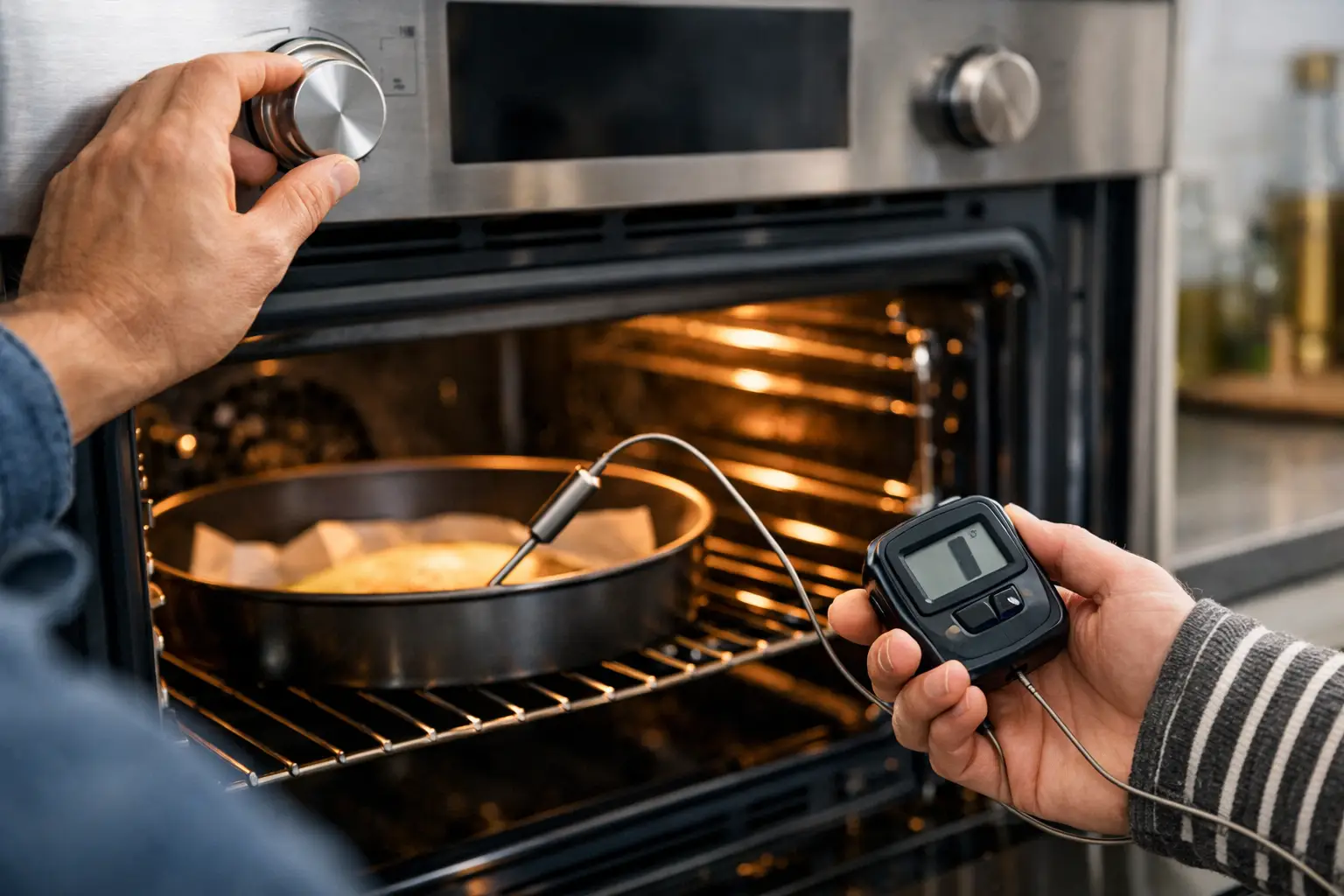
A cake browned on top but raw in the middle, or a roast that takes an extra hour, is more than a cooking frustration. It can be the first sign that the oven is not reaching or holding its set temperature. Knowing how to test oven thermostat performance gives you useful evidence before arranging a repair, but it also helps separate a genuine temperature fault from normal oven cycling or an inaccurate dial.
In many modern electric ovens, the temperature is controlled by an electronic sensor and circuit board rather than a traditional mechanical thermostat. The practical test is still the same: compare the temperature you set with the temperature the oven actually maintains. Do not dismantle the appliance or test live electrical parts. A safe, measured temperature check is the right starting point for homeowners, tenants and landlords.
What an oven thermostat fault can look like
An oven rarely sits at one exact temperature. It heats above the selected setting, switches off, then drops slightly before heating again. This cycle is normal. A reading that moves during preheating is not, by itself, proof that the thermostat has failed.
The concern is a consistent and significant difference. As a working guide, an oven that settles within around 10-15°C of its selected temperature is often performing reasonably. A difference of 20°C or more, especially when it happens on repeated tests, deserves further investigation. The acceptable margin can vary by appliance design, age and manufacturer guidance.
Common signs include food cooking unevenly, cooking times becoming unreliable, the oven burning food at familiar settings, or the oven taking far too long to heat. You may also notice that the temperature light behaves strangely, although this is less useful on models with electronic displays.
Poor results do not always point to the thermostat. A weak fan, faulty heating element, damaged door seal, incorrect clock setting, poor shelf position or blocked fan cover can create similar symptoms. That is why a controlled test matters.
How to test oven thermostat accuracy with a thermometer
You will need a reliable oven thermometer designed for high temperatures, an oven glove and a note of the readings. A digital probe thermometer can be useful if its probe is rated for oven use, but a purpose-made oven thermometer placed on a shelf is usually the simplest option.
Start with a cold, empty oven. Remove trays, baking dishes and foil, as these can affect airflow and make the result less representative. Place the thermometer in the centre of the middle shelf, not against the back wall, door glass or a heating element.
Set the oven to 180°C using its conventional or fan setting, depending on the function you use most often. Fan ovens generally cook at a lower displayed setting than conventional ovens, so make sure you are comparing like with like. If you normally cook at 180°C fan, test the fan function at 180°C.
Allow the oven to preheat until it indicates that it has reached temperature, then leave it running for a further 15 to 20 minutes. This extra time lets the cavity, shelves and air temperature settle after the initial heat-up.
Check the thermometer without keeping the door open for long. Record the temperature, then take two or three further readings at five-minute intervals. Ovens cycle on and off, so the average is more meaningful than a single number. If your thermometer shows 170°C, 182°C and 176°C while the oven is set to 180°C, the average is close enough that the thermostat is unlikely to be the main issue.
If readings repeatedly remain around 150°C or climb beyond 205°C at a 180°C setting, stop relying on cooking times and temperatures until the appliance has been assessed. An oven that consistently overheats can burn food and may become a safety concern, particularly if the controls, door seal or wiring are also deteriorating.
Repeat the test at a second temperature
For a more dependable result, let the oven cool and repeat the process at 200°C or 220°C. A thermostat or electronic sensor can behave differently at higher temperatures. Testing two settings also reduces the chance that a single faulty thermometer reading leads you in the wrong direction.
Write down the selected setting, the function used, the readings and whether the oven was empty. This gives an engineer a much clearer starting point and can shorten diagnosis time on the visit.
Check the things that can distort the result
Before assuming the thermostat has failed, inspect the basics with the appliance switched off and cool. Look for a door seal that is split, flattened or pulling away from the frame. Heat escaping through a poor seal can make the oven struggle to maintain temperature and can lead to uneven cooking.
Check that the shelves are fitted correctly and that the fan cover is not obstructed. In a fan oven, weak or intermittent fan operation can leave hot and cool areas in the cavity. Food may cook unevenly even if the central thermometer reading appears reasonable.
Consider the thermometer too. Cheap oven thermometers can be inaccurate, especially after prolonged use. If the reading seems surprising, compare it with a second thermometer before booking a repair solely on that result. The test is a diagnostic guide, not a laboratory calibration.
Finally, confirm you are using the intended cooking mode. Grill, defrost, top heat, bottom heat, fan oven and conventional oven functions behave differently. A setting mistake is common on unfamiliar appliances and after a control knob has been removed or replaced.
When the fault is likely to be more than calibration
Some ovens have a calibration setting in the control menu that allows a small temperature adjustment. This can be appropriate where the oven is consistently only slightly high or low and the manufacturer instructions specifically permit it. Do not use calibration to mask a large difference, repeated overheating or an intermittent fault.
A larger or unstable temperature error may be caused by a failed temperature sensor, a mechanical thermostat, a heating element, cooling fan issue, selector switch, wiring fault or control board. These parts need correct testing and, where necessary, replacement with the right component for the model.
The pattern of the fault can offer a clue. If the oven heats very slowly, one of the elements may not be working. If it overheats on every setting, the sensor, thermostat or control system may not be regulating the heat. If it works sometimes but not others, an intermittent electrical connection or electronic fault is possible.
For built-in and hard-wired cookers, repairs should be carried out by a competent appliance engineer or qualified electrician. Do not remove panels, bypass a thermal cut-out or attempt resistance tests unless you are trained and have safely isolated the supply. Cookers involve high current circuits, sharp panels and components that can retain heat long after switch-off.
Stop using the oven and arrange help if necessary
Switch the oven off at the controls and isolate the supply if you notice burning smells, smoke, sparking, a tripping consumer unit, a cracked element, melted controls or an electric shock. These are not thermostat-testing issues to monitor over time. They need prompt professional attention.
For landlords and property managers, a temperature fault should be logged and addressed quickly. An unreliable oven can disrupt a tenancy, while signs of overheating or electrical damage require a more urgent response. Keeping the test readings and a short description of the symptoms helps make the repair visit more efficient.
FaultFree Engineering Group can diagnose oven temperature faults across London, checking the appliance as a complete system rather than replacing a thermostat on assumption. Accurate testing, clear findings and the correct repair protect both the appliance and the people using it.
If your readings show a persistent temperature gap, avoid compensating by guessing at a higher or lower setting. Use the evidence from your thermometer test, cook cautiously if safe to do so, and arrange a proper diagnosis before a small cooking problem becomes a larger appliance or electrical fault.