
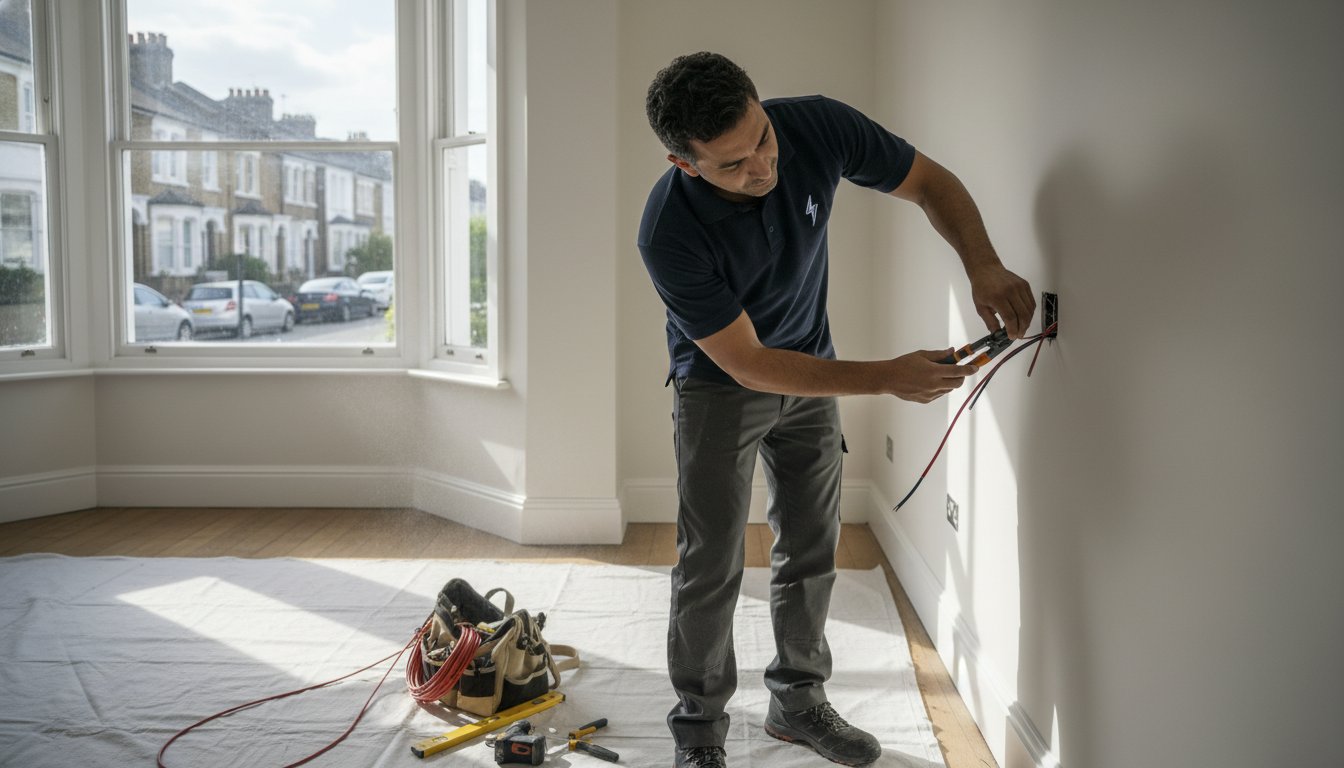
What if you could plan a full house rewire in London with complete certainty, knowing exactly when the power goes off and when your life returns to normal? It’s a major project, and the thought of dust, displaced furniture, and lifted floorboards is enough to cause serious anxiety. For most homeowners, the uncertainty around how long does it take to rewire a house is the biggest hurdle, especially with the unique access and logistical challenges of London properties.
We understand your concerns. That’s why we’ve created this definitive 2026 timeline guide. Forget vague estimates. Here, you will get a realistic, day-by-day breakdown for everything from a 2-bedroom terrace in Hackney to a 5-bedroom detached home in Richmond. We’ll walk you through each stage, from the initial survey to the final plastering, so you can plan with confidence, minimise disruption, and decide if you really need to move out.
Key Takeaways
- Learn the typical rewire duration for a London flat versus a 3-bed semi, and why property size isn’t the only factor influencing the timeline.
- Find out why rewiring an empty property can be up to 40% faster and how Victorian wall construction will impact the project’s length.
- Get a clear breakdown of the “First Fix” and “Second Fix” stages to accurately estimate how long does it take to rewire a house from start to finish.
- Uncover the unique challenges of rewiring in London, from navigating period architecture to the impact of parking and ULEZ on your electrician’s schedule.
Average House Rewire Timelines by Property Size
One of the first questions homeowners ask is, “how long does it take to rewire a house?” The answer depends almost entirely on the size and complexity of your property. As a general rule of thumb, our certified electricians budget one full day per bedroom, plus an additional two days for communal areas like the kitchen and living room. For a typical 3-bedroom house, this provides a baseline estimate of around five days.
However, this is just a starting point. A 2-bedroom new-build in a suburb with stud walls and easy access is a very different project from a 2-bedroom Victorian flat in Central London. Urban properties, particularly in London, often face unique challenges. Restricted parking for work vans, limited access through communal areas, and the prevalence of solid concrete or brick walls can extend the project timeline compared to a suburban semi-detached house with more straightforward construction.
The method of installation also plays a crucial role. A full “flush rewire” is the modern gold standard, but it’s also the most time-consuming. This method ensures all new wiring is completely concealed and complies with current UK wiring standards, such as BS 7671, for maximum safety and a clean aesthetic. The alternative, a “surface rewire,” is much faster but involves visible trunking.
Timeline Estimations for London Properties
Based on hundreds of completed projects by our qualified teams across London, here are our typical timeframes for a comprehensive flush rewire. These estimates assume the property is unoccupied or has minimal furniture, which allows for maximum efficiency.
- 1-2 Bedroom Flat: 2 to 4 days. The key variable here is construction. Flats with solid concrete floors and ceilings require more intensive labour for chasing channels, pushing the project towards the 4-day mark.
- 3 Bedroom Semi-Detached House: 5 to 8 days. This is the most common project we undertake. A dedicated team of two to three electricians can typically complete the first fix (chasing and cabling) in 3-4 days, with the second fix (installing sockets, switches, and the consumer unit) taking another 2-3 days.
- 4-5 Bedroom Detached/Townhouse: 10 to 15 days. Larger properties with multiple floors, more complex circuits, and a higher number of electrical points naturally require more time. These projects are meticulously planned to ensure efficient progress without compromising on safety or quality.
Surface vs. Flush Rewiring Speed
Choosing between a surface-mounted or a flush-in installation is a critical decision that directly impacts how long it takes to rewire a house. Your choice affects the project’s speed, cost, and final appearance.
- Surface Wiring: This method uses plastic trunking to house the new cables on the surface of the walls. It eliminates the need for chasing and replastering, potentially saving up to 30% of the total project time. It’s a practical solution for workshops, garages, or properties where budget and speed are the top priorities.
- Flush Wiring: As the London standard, this involves cutting channels (chasing) into the walls, laying the cables within, and having the walls replastered for a seamless, invisible finish. While this delivers a superior look, the process of chasing, making good, and allowing for plaster to dry can add 2 to 4 days to the overall schedule.
- Number of Points: The duration scales directly with the number of sockets, light fittings, and switches you need. A kitchen renovation requiring 15 new double sockets, under-cabinet lighting, and an oven circuit will take far longer than a simple bedroom rewire with just four sockets and one light pendant.
Factors That Accelerate or Delay Your Rewire
The baseline estimate of 5-8 days for a 3-bed house rewire assumes ideal conditions. In reality, several critical factors can significantly alter this timeline. Understanding these variables is key to answering the question, “how long does it take to rewire a house” for your specific property. The single biggest factor is whether you are living in the property during the work.
Occupied vs. Unoccupied Properties
An empty, unfurnished property is an electrician’s dream. We find that working in an unoccupied house is up to 40% faster than working in an occupied one. The reasons are simple and practical. Our certified electricians spend at least two hours every day moving furniture, laying down extensive dust protection, and packing up tools to leave the space habitable. This is time that could be spent running cables.
Furthermore, in an occupied home, we must maintain “evening power.” This means ensuring you have functional lights and power sockets at the end of each day, which requires making temporary connections that are removed the next morning. This stop-start process slows progress considerably. For our London clients, we strongly recommend vacating the property for at least the “First Fix” stage (the initial 4-5 days of chasing walls and running cables) to achieve the fastest, most efficient result.
Technical and Structural Obstacles
The age and construction of your home present the next set of challenges. A modern home with plasterboard and stud walls allows electricians to run cables through wall cavities with relative ease. In contrast, a Victorian or Edwardian property with solid brick walls and fragile lath-and-plaster requires “chasing” – cutting channels into the brickwork. This process is noisy, incredibly dusty, and can easily add 2-3 days to the project.
Your home’s finishes also play a major role. Lifting standard floorboards is a routine task. However, if you have high-end finishes like solid oak parquet, marble tiles, or expensive engineered flooring, these materials must be lifted and reinstated by a specialist to avoid damage, adding significant time and cost.
Here are some common structural hurdles we encounter:
- Solid Concrete Floors: Common in 1960s London blocks, these floors prevent running cables underneath. We must use specialised routing techniques and more trunking, which affects both the timeline and the final aesthetic.
- Consumer Unit Location: A fuse box tucked away in a tight, inaccessible cupboard requires more time to work on than one with clear access under the stairs. Moving the unit to comply with current regulations can also add a full day’s work.
- Asbestos Discovery: This is the number one timeline killer in older UK properties. If our electricians suspect asbestos-containing materials (ACMs), all work must stop immediately by law. The material must be tested by a UKAS-accredited lab and removed by a licensed specialist before we can safely continue. This process can delay a project by weeks. A pre-rewire survey can sometimes flag high-risk areas, but surprises are always possible.
Navigating these issues requires a qualified and experienced team. All our work is performed in strict compliance with BS 7671, the standard mandated by UK government electrical safety standards. If you have concerns about the existing state of your wiring, a professional assessment is the best first step. Our experts specialise in all forms of electrical works, from fault finding to full-scale rewires, providing the clarity you need.
The Two-Stage Rewiring Process: First Fix vs. Second Fix
A full house rewire isn’t a single, continuous job. It’s a project split into two distinct phases: the ‘first fix’ and the ‘second fix’. Understanding this separation is key to answering the question of how long does it take to rewire a house and for planning around the disruption. There is often a necessary gap between these stages, allowing for other trades like plasterers to make good the walls before the final electrical fittings are installed.
First Fix: Duration and Expectations
The first fix is the structural installation of all new cables and back-boxes. This is the ‘behind-the-scenes’ work forming your home’s new electrical backbone. It’s the most disruptive phase, taking 60-70% of the total job time. For a 3-bed house, expect 3 to 6 days of lifting floors and chasing walls. The significant noise and dust mean the property is often uninhabitable during this critical stage, which is the largest factor in the overall project timeline.
Second Fix and Final Commissioning
After any plastering is done, our qualified electricians return for the second fix. This is the ‘clean stage’ with rapid visual progress. We connect all accessories to the new wiring, fitting socket faceplates, light switches, and the new consumer unit. It’s a satisfying phase where rooms look complete again. Once sockets are live, the final steps can occur, like professional appliance installation for a new electric oven.
The final, critical step is commissioning and testing. This isn’t a quick check; it’s a mandatory and meticulous process that takes between 4 and 8 hours for a full property. Our certified electricians conduct a series of dead and live tests to ensure every circuit is safe, functional, and fully compliant. This rigorous inspection proves the installation adheres to BS 7671, the national standard, and meets all UK government electrical safety standards. Upon successful completion, you will be issued an Electrical Installation Certificate (EIC), your official guarantee of a safe and professional job.
London-Specific Challenges for House Rewiring
Rewiring a property in London is a different beast entirely. The city’s unique character, historic architecture, and logistical hurdles mean that a standard timeline rarely applies. Answering the question of how long does it take to rewire a house in the capital requires a deep understanding of challenges you simply won’t find elsewhere. These factors can add days, and sometimes weeks, to a project’s duration.
From navigating century-old buildings to the simple act of parking a van, every step demands specialist local knowledge. A qualified electrician working in London must be a problem-solver, a historian, and a logistics expert all in one.
Victorian Property Nuances
London’s vast stock of Victorian and Edwardian homes presents beautiful but complex challenges. These properties were built with materials and techniques vastly different from modern construction. Our certified electricians are trained to work with extreme care to preserve original features like delicate plaster coving and ornate ceiling roses, which can add significant time to the chasing process. We conduct a “Void Search” to locate viable routes for new cables through solid brick walls and lath-and-plaster ceilings, a task that requires patience and precision. Furthermore, in terraced houses, installing mandatory fire-stopping between floors and party walls is a non-negotiable safety step that adds another layer to the project timeline.
Logistics and Access in the City
Simply getting to your property and having the right materials on-site can be a major daily hurdle. The operational costs and time spent on city logistics directly influence how long it takes to rewire a house. These daily delays accumulate quickly.
- Parking & Transport Fees: Our work vans are subject to the daily £12.50 ULEZ charge and, in central areas, the £15 Congestion Charge. Securing a tradesperson’s parking permit from a local council can take several days and add to the project’s overhead. A delayed start each morning waiting for a parking space is a common issue.
- Access Issues: Rewiring a multi-story flat involves the “Stairs Factor.” Manually carrying heavy cable drums, tools, and materials up several flights of stairs adds hours of labour compared to a ground-floor project.
- Waste Management: Arranging a skip permit in a dense London borough like Hackney or Islington can be a slow process with strict placement rules. This can delay the start of the “first fix” and the removal of old wiring and debris.
- Permissions: If your home is a listed building or in a conservation area, you will need special consent from your local authority before any work can begin. This process can add months to your project’s start date.
Understanding these on-the-ground realities is critical for an accurate project plan. To get a clear picture of the specific challenges at your property, it’s best to contact us for a London-specific site survey.
Don’t let these challenges overwhelm you. A professional team with extensive London experience anticipates these issues and builds them into the project plan from day one, ensuring a smooth and efficient process. For a precise timeline that accounts for London’s unique demands, get a professional assessment from our certified electricians.
Minimizing Disruption: The FaultFree Approach
Understanding the timeline is a crucial part of the question, “how long does it take to rewire a house?” At FaultFree Engineering Group, we believe the answer shouldn’t just be about days, but about how those days impact your life. A rewire is inherently disruptive, but our “Tested-Trusted” project management system is engineered to minimise that disruption. We deliver a fast, professional, and transparent service that gets your London home back to normal, faster. Our entire process is built around a single goal: to deliver a safe, modern, and fully compliant electrical system with the least possible inconvenience to you and your family.
We combine meticulous planning with a solution-oriented workflow. This includes our “Life-Safe” guarantee, where we strategically manage the project to keep essential appliances, like your fridge freezer and a dedicated power point for charging devices, running for as long as possible each day. You get a home that’s not just safer, but also functional throughout the process.
Future-Proofing Your London Home
A rewire is the perfect opportunity to prepare your home’s electrical system for the next 25 years. We don’t just replace old wires; we install a system designed for modern living. This includes planning for future demands to prevent costly and disruptive work later on. Our future-proofing includes:
- Dedicated Appliance Circuits: We install separate, high-capacity circuits for power-hungry appliances. This ensures your washing machines and dishwashers run safely without tripping your system.
- EV Charger Preparation: Planning to get an electric vehicle? We can run the necessary armoured cable to your desired charge point location during the rewire. This simple step saves you an estimated £300 and a full day of separate installation work in the future.
- Smart Home & Connectivity: We can run Cat6 data cables to key areas, eliminating Wi-Fi dead zones and preparing your home for integrated smart lighting, security cameras, and home hubs.
Our Professional Efficiency Guarantee
Our qualified, multi-man teams work in a highly coordinated manner to accelerate the project timeline without compromising on quality or safety. A standard rewire that might take a solo electrician 10-12 days, our teams can typically complete in just 6-7 days. This efficiency is a core part of our service. We provide transparent, daily updates on our progress and which circuits will be energised overnight, so you’re never left in the dark about the project’s status.
The job isn’t finished when the power is back on. Our final “FaultFree Engineering Group” inspection goes beyond the standard Electrical Installation Condition Report (EICR). We conduct a comprehensive system-wide check, testing every switch, socket, and circuit under load to ensure flawless performance. This final sign-off is our promise that your home isn’t just compliant; it’s truly FaultFree, giving you complete peace of mind and answering the question of how long does it take to rewire a house with a definitive, quality-assured finish.
Secure Your 2026 Rewire Timeline Today
We’ve established that a typical 3-bedroom London home rewire can take between 5 and 10 days. However, the exact answer to how long does it take to rewire a house depends entirely on your property’s specifics, from its age to whether you’ll be living there during the work. Planning for both the disruptive ‘first fix’ and the final ‘second fix’ is essential for a smooth, predictable project.
Don’t leave your timeline to guesswork. For a precise and dependable schedule, you need professional assessment. The FaultFree Group provides a clear path forward. Our team of NICEIC Certified Electricians delivers expert work and peace of mind with our transparent, fixed-quote pricing. While we’re known for our same-day response for emergency faults, our true value lies in meticulous planning for major projects like yours.
Ready to get a firm date in your calendar? Book Your London House Rewire Survey with FaultFree Today and take the first step towards a safer, fully updated home.
Frequently Asked Questions
Can I stay in the house while it is being rewired?
Yes, you can stay in your home, but we strongly advise against it. A rewire is an extremely disruptive process involving significant dust, noise, and constant movement from our qualified electricians. Temporarily relocating allows our team to work more efficiently and safely, often reducing the overall project time. If you must stay, be prepared for daily interruptions and limited access to certain rooms while work is underway. We will always ensure you have basic power overnight.
Do electricians tidy up and replaster after a rewire?
Our professional electricians will always tidy up at the end of each day, collecting debris and leaving the work area as clean as possible. However, the standard electrical quote does not include replastering or redecorating. Chasing cables into walls requires a plasterer to make good the surfaces afterwards. We can recommend trusted plasterers or you can arrange your own. Always confirm the full scope of work in your written quote to ensure complete transparency.
How long will I be without electricity during a rewire?
You won’t be without power completely for the entire project. Our certified electricians work on a circuit-by-circuit basis, meaning power is only cut to the specific areas being worked on during the day. We always aim to restore power to essential appliances like your fridge, freezer, and some lights each evening. The only time for a total outage is typically for 2-4 hours on the final day when we switch over to your new consumer unit.
Is it possible to rewire a house in stages?
Yes, it is possible to rewire a house in stages, often called a phased rewire. This can be done on a room-by-room or floor-by-floor basis to minimise disruption. While this approach offers flexibility, it’s important to understand it will extend the overall timeline and can increase the total cost by 15-20% due to multiple visits. Discussing this with us beforehand helps determine how long does it take to rewire a house with this method and if it’s the right choice for you.
Does a house rewire include a new consumer unit?
Yes, a full house rewire always includes the installation of a new, modern consumer unit (often called a fuse box). This is a critical part of the process and a legal requirement to meet current UK electrical safety standards, BS 7671. Your new unit will feature Residual Current Devices (RCDs) and Miniature Circuit Breakers (MCBs) for superior protection against electric shock and fire, keeping your home and family safe. It’s a non-negotiable part of a professional rewire.
Will my internet and Wi-Fi be affected during the rewire?
Yes, your internet and Wi-Fi will be temporarily affected. The power to your router will be cut off when our electricians are working on that specific circuit. Additionally, if your telephone or data cables run alongside the old electrical wiring, they may need to be carefully moved. We recommend you plan for intermittent connectivity during the day. It’s a good idea to have a mobile data plan as a backup for essential online access during the project.
Do I need a permit from the council to rewire my London home?
You don’t need to apply for a permit yourself. In the UK, a full rewire is classed as “notifiable work” under Part P of the Building Regulations. As a certified company registered with a competent person scheme like NICEIC, we handle this for you. After completing the work, we self-certify that it meets all safety standards and notify your local London council on your behalf. You will then receive an official Building Regulations Compliance Certificate by post.
How much mess does a full house rewire actually create?
A full rewire is an invasive job that creates a significant amount of mess, primarily fine dust from chasing channels into plaster and brick walls. It also involves lifting floorboards and drilling access holes. While our professional team uses dust sheets and containment measures, dust is unavoidable and will settle everywhere. We strongly advise you to remove all valuable items and cover furniture in every room with protective plastic sheeting before the work begins.
Tags: electrical work, electrician, first fix electrics, Home Improvement, home renovation, house rewire, London property, rewire timeline, Victorian house