
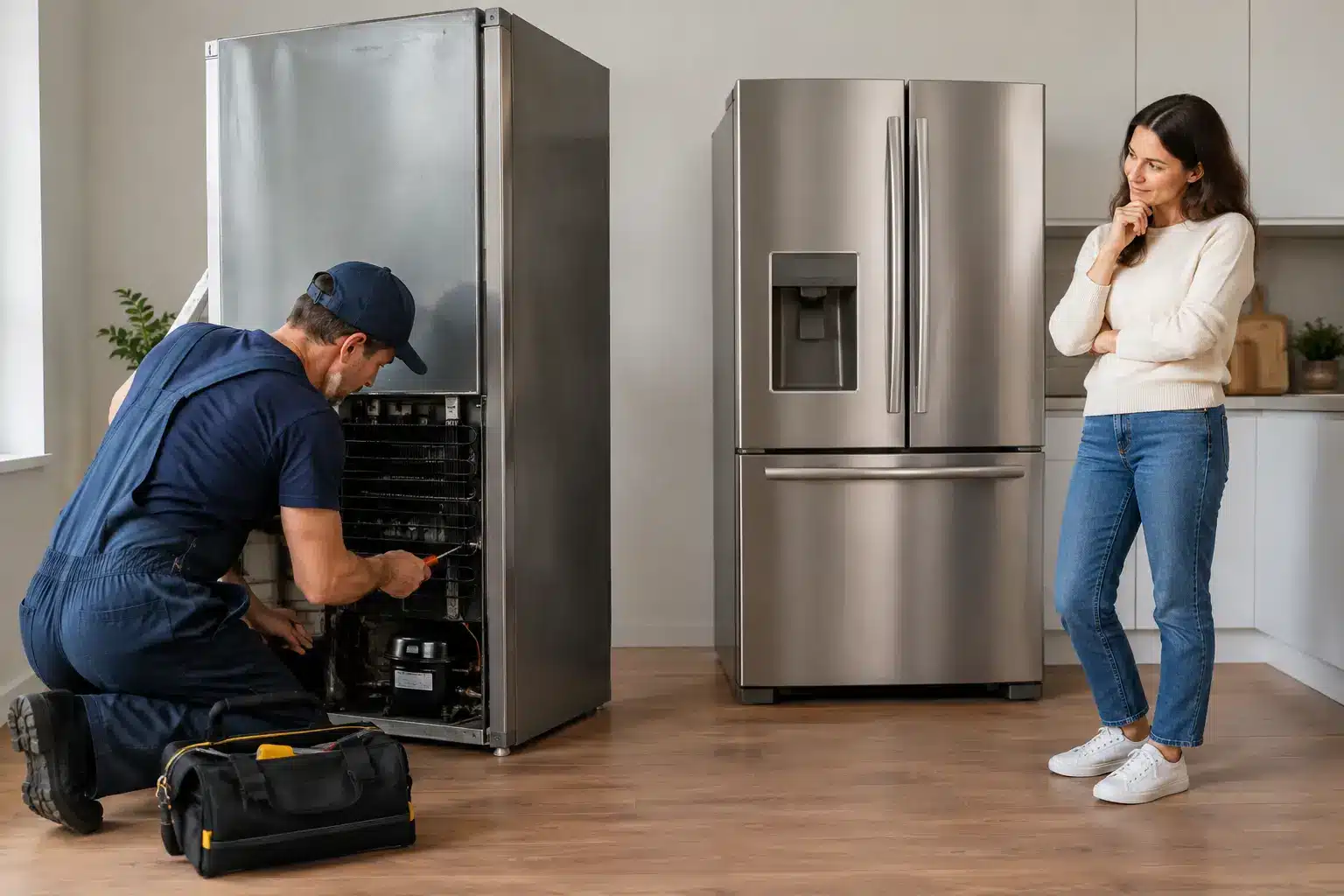
A fridge that is running but no longer cold enough can turn into an expensive problem quickly. Food spoils, freezer items start to soften and the kitchen becomes a source of stress. When weighing up repair versus replace fridge, the right answer is rarely based on age alone. The fault, the appliance’s condition, the cost of the repair and its likely remaining working life all matter.
A professional diagnosis gives you the facts before you spend money. Some faults are straightforward and economical to put right. Others point to a major sealed-system failure or an appliance that is nearing the end of its useful life. The aim is not to push a repair or a replacement. It is to make the most sensible decision for your home, rental property or business.
Repair versus replace fridge: start with the fault
The same symptom can have very different causes. A fridge that is not cooling may have a failed thermostat, temperature sensor, fan motor, start relay, blocked drain or damaged door seal. These issues are often repairable, provided suitable parts are available and the cabinet is otherwise in good condition.
A noisy fridge is another example. Rattling may come from a loose component, an obstructed fan or uneven feet. A persistent loud hum, repeated clicking or the compressor running almost constantly can be more serious. An engineer can test the electrical components, airflow and cooling system rather than guessing from the sound alone.
The faults most likely to make replacement worth considering are compressor failure, a refrigerant leak within the sealed system, severe corrosion, or damage to the insulation and cabinet. These repairs can be technically demanding and may not offer good value on an older appliance. That does not mean every compressor-related issue requires a new fridge, but it does mean the diagnosis needs to be accurate before approving work.
Age matters, but it is not the whole decision
Many fridge freezers last around 10 to 15 years, although lifespan varies by brand, model, usage and maintenance. An appliance that is five or six years old with a repairable fan or sensor fault will often be a strong candidate for repair. Replacing it solely because it has stopped cooling for a day can be unnecessary.
Once a fridge is beyond 10 years old, the calculation changes. A high-cost repair may only buy limited extra life, particularly if the compressor has been working hard, door seals are tired or replacement parts are becoming difficult to obtain. An older unit may also use more electricity than a modern equivalent, especially if it has damaged seals or poor temperature control.
However, age is a guide, not a rule. A well-built integrated fridge that fits a specific kitchen cabinet may be worth repairing even when it is older. Replacing an integrated appliance can involve matching dimensions, hinge type, ventilation requirements and door alignment. The cost is not just the price of a new fridge – it can also include installation and adjustments to the kitchen unit.
Use the repair cost in context
A common rule is to consider replacement when a repair costs more than half the price of a comparable new appliance. It is a helpful starting point, but it should not be treated as an automatic answer.
For example, a £180 repair on a fridge that would cost £400 to replace may seem too high at first glance. Yet if the existing appliance is only four years old, in good overall condition and suitable parts are fitted, repair may still be the more practical choice. It avoids the disruption of delivery, disposal and installation, and it keeps a functioning appliance in service.
On the other hand, a £250 repair on a 13-year-old fridge freezer with worn seals, rising energy use and intermittent cooling may be poor value even if a replacement costs considerably more. The risk is paying for one fault only for another age-related component to fail soon afterwards.
Ask for a clear explanation of the diagnosed fault, the required parts, labour cost and what the repair is expected to achieve. Transparent pricing is especially useful for landlords and property managers, who need to balance cost control with providing tenants with safe, reliable appliances.
Check performance before blaming the fridge
Not every cooling problem is an internal failure. Poor ventilation around the appliance, a fridge packed too tightly, a door left slightly open or a build-up of dust around the condenser can all affect performance. Frost accumulation in a frost-free freezer may also point to a door seal, defrost or airflow issue rather than complete appliance failure.
Before booking a visit, check that the thermostat has not been knocked to a warmer setting and that the appliance has space around its vents. Look for obvious tears or gaps in the door seal. Do not chip ice away with a knife or attempt to dismantle electrical covers. A punctured cooling line can turn a manageable fault into a major repair.
If the fridge has stopped cooling, keep the doors closed as much as possible and move vulnerable food to another appliance or a cool box with ice packs where practical. If food has been above a safe temperature for too long, it should not be kept simply to avoid waste.
When replacement is the sensible option
Replacement is often the better long-term decision when the fridge has repeated breakdowns, major cooling-system faults or expensive obsolete parts. It may also be the better choice where the appliance is too small for the household, has excessive energy consumption, or no longer meets the needs of a rental property or commercial setting.
Consider replacement if several of these apply:
- The fridge is over 10 years old and has needed more than one repair recently.
- The compressor or sealed cooling system has failed and the repair is costly.
- Parts are discontinued or cannot be sourced within a reasonable time.
- The cabinet, hinges, seals or insulation are badly deteriorated.
- Energy use is high and temperature control is inconsistent.
A new appliance should be chosen carefully, not just bought quickly. Check dimensions, door clearance, ventilation requirements and whether the appliance is freestanding or integrated. For integrated models, confirm the hinge system and cabinet size before delivery. A fridge that does not fit correctly can overheat, run inefficiently and cause further inconvenience.
Safety and food storage should come first
A fridge fault can sometimes involve electrical safety as well as cooling performance. Tripping electrics, a burning smell, a damaged plug, overheating at the rear or repeated fuse failures should be treated seriously. Switch the appliance off at the socket if it is safe to do so, avoid using damaged cables and arrange a qualified inspection.
Refrigerant work and compressor repairs should never be a DIY job. These systems need the correct tools, testing and handling procedures. The same applies to electrical fault finding. An apparent appliance issue can occasionally be linked to a socket, circuit or supply problem, which is why engineering and electrical expertise under one provider can be valuable.
For landlords, a fridge that cannot safely maintain temperature is more than an inconvenience. Prompt action helps protect tenants’ food, reduces complaints and limits the risk of a small issue becoming an emergency callout. Keeping a record of diagnosis and repairs also supports planned maintenance across a portfolio.
Make the decision with a proper diagnosis
The best repair versus replace fridge decision comes after the cause of the fault is confirmed, not after comparing online prices or relying on a single symptom. A qualified engineer can assess the appliance’s cooling performance, electrical components, parts availability and general condition, then explain the realistic options without jargon.
FaultFree Engineering Group provides practical fridge freezer diagnosis and repair support across London, with clear advice on whether a repair is worthwhile. If replacement is the better route, you can move forward knowing you have not spent money blindly on a short-lived fix.
A fridge should keep food cold, run predictably and give you one less thing to worry about. Whether that means a targeted repair or a carefully chosen replacement, a clear diagnosis is the fastest route back to a working kitchen.