
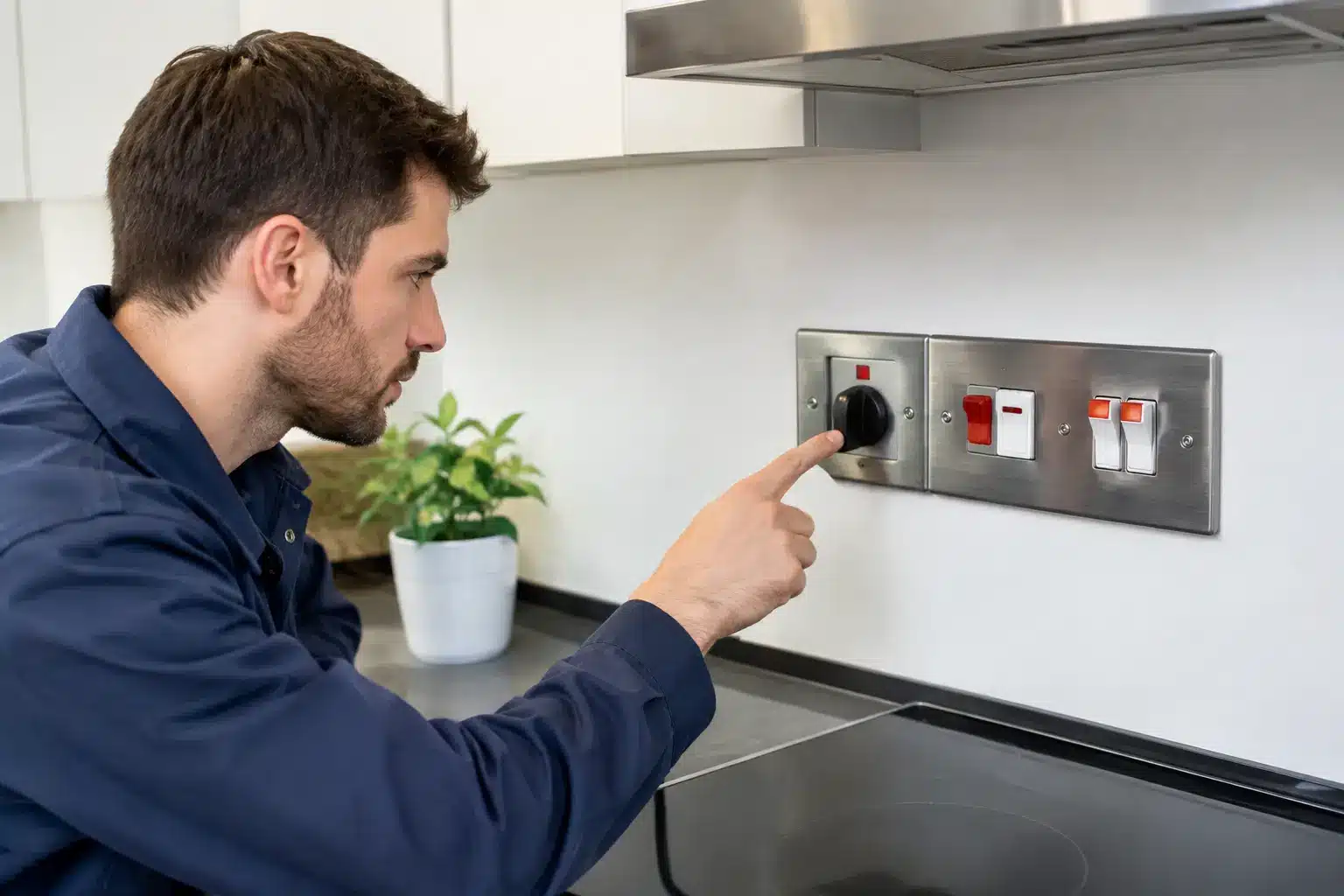
A cooker stops working at the worst possible time, and the first question is often whether the wall switch has been knocked off, tripped, or failed. Knowing how to identify cooker switch types can help you make a safe first check without taking risks with a high-load electrical circuit. The key is recognising what the switch is designed to do, rather than assuming every switch near the kitchen worktop controls the cooker.
What Is a Cooker Switch?
In most UK homes, a cooker switch is a dedicated isolation switch for an electric cooker, built-in oven, electric hob, or a combination of these appliances. It lets you disconnect the appliance from its electricity supply without switching off power to the entire property.
The most common type is a large wall-mounted cooker control unit. It is usually rated at 45 amps or 50 amps and often has a prominent red rocker switch. Many have a red neon indicator light that illuminates when the circuit is live. You may see the words “Cooker”, “Cooker Control Unit” or “Cooker Switch” printed on the faceplate, but labelling is not guaranteed, particularly in older properties or after a kitchen refurbishment.
A cooker switch is not the same as the controls on the oven or hob. The temperature dials, touch panel and timer operate the appliance. The wall switch isolates its electrical supply.
Where You Will Usually Find a Cooker Switch
A correctly positioned cooker switch should be easy to reach without leaning over a hot hob. In many London kitchens, it is installed on the wall near the kitchen entrance, above the worktop and away from direct heat or splashes. It may also be on a nearby wall outside a compact galley kitchen.
In some layouts, especially where a new kitchen has been fitted into an older flat, the control unit can be tucked behind a cupboard door or located in an adjacent utility area. It should not be hidden directly behind the cooker where you would need to move the appliance to access it.
Do not rely on location alone. A switch near the oven could control an extractor hood, under-cupboard lighting or a fused spur for another appliance. Check the rating, markings and the cable arrangement before drawing a conclusion.
The visual signs of a cooker control unit
A cooker switch normally stands out from a standard light switch or socket because it is larger and built for greater electrical demand. Look for these practical signs:
- A wide faceplate with a large red, white or black rocker switch.
- A rating of 45A, 50A or occasionally another high-current rating marked on the front.
- A neon light, often red, showing that the supply is on.
- The word “Cooker” or an appliance isolation label.
- A standard 13A socket beside the switch on some combined cooker control units.
The presence of a socket does not mean the socket powers the cooker. On a combined unit, the socket is normally a separate 13A supply for a kettle, blender or other small appliance, while the larger switch controls the dedicated cooker circuit.
Cooker Switch, Fused Spur or Standard Socket?
This is where many householders make the wrong identification. A fused connection unit, often called a fused spur, is a smaller plate with a 3A, 5A or 13A fuse inside. It may feed a cooker hood, ignition system, clock, boiler or lighting circuit. It is not normally suitable as the main isolator for a full-size electric cooker or high-powered hob.
A standard wall socket has a 13A rating and accepts a normal three-pin plug. Some small plug-in ovens can use one, but most electric cookers and many induction hobs require a dedicated higher-rated circuit. Never assume a cooker can be plugged into a normal socket simply because it has a standard plug fitted. The appliance rating and installation arrangement must be suitable.
You may also find a double-pole isolator. This disconnects both live and neutral conductors when switched off, improving safety during maintenance. Most modern cooker control units are double-pole, but the wording or symbol may be subtle. An electrician can confirm the setup and test whether the circuit is safe if there is any doubt.
How to Identify a Cooker Switch Without Removing Covers
Start with a visual inspection only. Do not remove the faceplate, unscrew fittings or touch wiring. Even if the switch is off, parts of the installation can remain live, and damaged accessories can be dangerous.
First, look for a dedicated label and a 45A or 50A rating. Next, check whether the cooker, oven or hob loses power when the switch is turned off. Only do this when the appliance is cool and not in use. If the display goes blank, the oven light stops working and the hob controls are dead, you have probably found the correct isolator.
If the unit has a neon light, remember that it is only an indicator. A light that is off can mean the switch is off, the supply has tripped, the neon has failed, or there is a fault in the circuit. Likewise, a glowing neon does not prove that the cooker itself is healthy.
The consumer unit can provide a useful second clue. Look at the circuit directory on the consumer unit door or cover. A circuit marked “cooker”, “oven”, “hob” or “kitchen” may correspond to the control switch. However, circuit labels are sometimes outdated, vague or incorrect after alterations. Treat them as guidance, not proof.
What about gas cookers?
A gas cooker may still have an electrical connection for ignition, a clock, a light or a fan. That supply is often a normal plug or fused spur rather than a 45A cooker switch. The isolation valve for the gas supply is separate and should not be confused with an electrical control unit.
If you smell gas, do not test switches or electrical appliances. Turn off the gas supply only if it is safe to do so, ventilate the area, avoid flames and electrical sparks, and seek urgent professional support.
When the Cooker Switch May Be Faulty
A cooker switch can fail through wear, loose connections, overheating or electrical overload. High-demand appliances place substantial load on their circuit, especially older cookers, ceramic hobs and induction hobs used at full power.
Warning signs include a crackling sound, a burning smell, brown marks around the switch, heat from the faceplate, a loose rocker, flickering neon light or repeated tripping at the consumer unit. A switch that feels warm may be carrying load, but it should never become uncomfortably hot. Stop using the cooker if you notice heat damage or burning.
Repeated tripping needs proper diagnosis. It could be a fault in the cooker, oven element, hob, cable, switch, connection point or the protective device at the consumer unit. Resetting a tripped breaker repeatedly can worsen damage and removes the opportunity to identify a developing fault safely.
Do Not Confuse Isolation With Repair
Turning a cooker switch off is a sensible way to isolate an appliance while you wait for help. It is not a repair, and it does not make damaged wiring safe to handle. Cooker circuits are generally hard-wired and can involve high current, fixed cabling and connections behind the appliance.
It is particularly important to arrange a qualified electrical inspection if a new cooker has been installed recently, a switch has melted or discoloured, the circuit trips when the oven heats up, or the appliance has caused a fuse to blow. For landlords and property managers, electrical faults should be addressed promptly to protect tenants and maintain a safe, operational property.
FaultFree Engineering Group can assess both the appliance and the electrical installation, which matters when the source of the fault is unclear. A cooker that appears faulty may have a damaged control unit or connection, while a healthy circuit can still trip because an oven element has failed.
A Safe Next Step When You Are Unsure
If you have identified a likely cooker switch but the cooker still has no power, leave it switched off if there are signs of damage or tripping. Avoid dismantling the accessory or pulling the appliance forward to inspect connections. Take note of what happens – whether the neon is on, which appliance functions have failed and whether the consumer unit trips – as this helps an engineer diagnose the issue efficiently.
A clear label and a working switch make everyday use safer. If yours is unmarked, inaccessible, hot, noisy or unreliable, arranging a proper inspection is a practical way to protect your kitchen, your appliance and everyone using the property.