
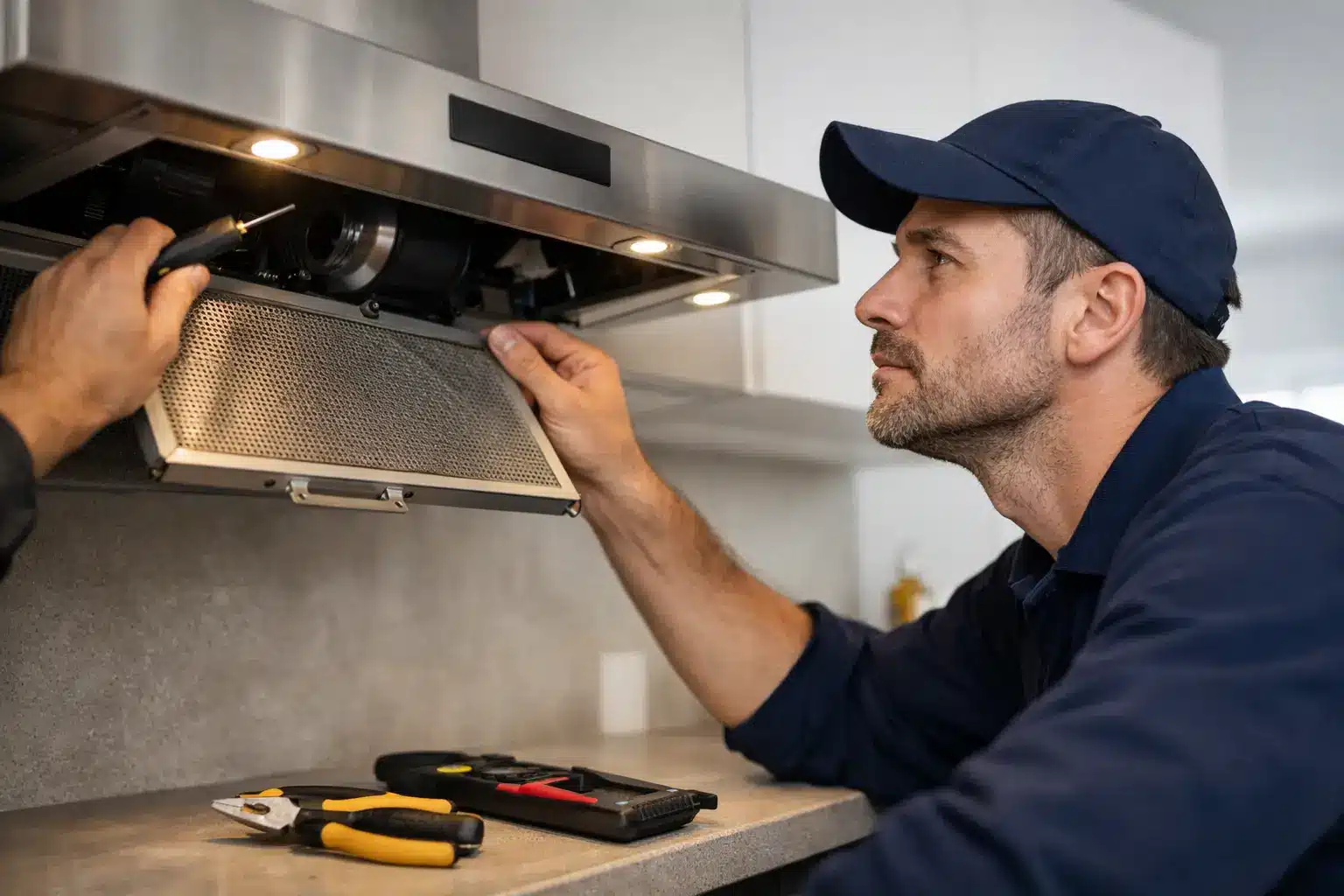
A cooker hood that suddenly stops extracting is more than a nuisance after dinner. Steam settles on cupboards, cooking smells travel through the property, and grease can build up where it should not. Prompt extractor hood repair helps keep the kitchen cleaner, more comfortable and safer to use – particularly in busy family homes, tenanted properties and commercial kitchens.
The right solution depends on the fault. Some issues are simple maintenance jobs, while others involve mains electrics, damaged wiring, failed controls or a motor that needs professional diagnosis. Knowing the difference can save time, avoid unnecessary parts and prevent a small fault becoming a larger repair.
Start with the symptom, not the guesswork
Extractor hoods generally fail in a few recognisable ways. The fan may not run at all, the lights may work while extraction does not, the hood may be noisy but pull very little air, or it may trip the consumer unit. Each symptom points to a different set of likely causes.
If there is no power to either the fan or lights, check whether the appliance is switched on at its fused spur or isolator. Also check the consumer unit for a tripped breaker. Do not keep resetting a breaker that trips again. This can indicate an electrical fault in the hood, its supply cable or a connected component.
When the lights work but the fan does not, the problem is often within the hood itself. Common causes include a failed motor, worn switch, faulty control board, capacitor fault or loose internal connection. On older models, mechanical slider switches can wear out. On newer touch-control models, moisture, heat and electronic component failure can affect the control panel.
A hood that runs but does not clear steam usually needs a different approach. The motor may be working perfectly, but airflow is restricted by blocked filters, a poorly fitted duct, a stuck external grille or an unsuitable recirculation setup.
What you can safely check before booking extractor hood repair
Before arranging a visit, there are a few sensible checks that do not require dismantling electrical parts. First, clean the metal grease filters. These filters collect airborne oil, and when heavily coated they reduce airflow, make the motor work harder and increase fire risk. Most can be removed and washed according to the manufacturer’s instructions, then fully dried before refitting.
If your hood recirculates air back into the kitchen, check the carbon filters as well. Carbon filters are not washable in most cases and need replacing at intervals based on how often you cook. A recirculating hood will never remove moisture from the home as effectively as a ducted model, but fresh filters can noticeably improve odour control.
For ducted hoods, look outside if the outlet is safely accessible. Leaves, nesting material, grease deposits and a jammed flap can restrict extraction. Avoid pushing tools into the ducting or removing covers where you cannot safely reach them. Flexible ducting can also become crushed or badly routed behind cupboards, and that requires a proper inspection.
You can also listen carefully. A rattling sound may mean a loose filter, fan blade obstruction or worn motor bearing. A loud hum with no fan movement can indicate a seized motor or failed capacitor. Burning smells, crackling, sparking, repeated tripping or visible heat damage are not maintenance issues. Switch the hood off at the isolator and arrange an engineer without delay.
Why poor extraction is not always a hood fault
It is easy to blame the appliance when the kitchen remains steamy, but extraction performance depends on the whole installation. A powerful motor cannot compensate for narrow, excessively long or sharply bent ducting. Every unnecessary bend slows the air, while a duct that ends in the loft or another enclosed space can cause damp and condensation problems.
The correct duct size also matters. Reducing a large outlet to a smaller duct can increase noise and lower airflow. Likewise, an external vent with a restrictive grille may create back pressure that makes the hood seem weak. These are installation issues rather than a failed appliance, and the repair should address the cause rather than simply replace parts.
In flats and rental properties, ventilation arrangements can be more complex. Some buildings have shared systems, restrictions on external vents or requirements set by the managing agent. A qualified engineer can establish whether the fault sits with the hood, the duct route, the external termination or the electrical supply before recommending work.
When a professional repair is the sensible option
Extractor hoods combine mains electricity, heat, grease and moving parts. That is why repairs involving internal wiring, motors, capacitors, circuit boards or switches should be handled by a competent engineer. Unplugging a hood is not always straightforward either, as many are hard-wired through a fused connection unit rather than connected to a visible socket.
A proper diagnosis starts with checking the supply and safe isolation, then testing components methodically. This prevents the common mistake of replacing a motor when the real issue is a control switch, or replacing a control board when a damaged cable is causing the fault. It also helps identify whether the repair is economical for the age and condition of the appliance.
Repair is often worthwhile where the hood is otherwise in good condition and the fault is confined to a serviceable component. Replacement may be more sensible if the motor, controls and casing have deteriorated together, if replacement parts are obsolete, or if the existing model has never provided adequate extraction for the kitchen. The decision should be based on a clear diagnosis and transparent pricing, not a guess.
FaultFree Engineering Group provides extractor hood and wider appliance support across London, with engineers able to assess appliance faults alongside related electrical issues. That joined-up approach is useful where a hood problem may be connected to its fused spur, supply cable or circuit rather than the appliance alone.
Common extractor hood faults an engineer can diagnose
Most service calls fall into a small number of categories:
- The hood has no power because of a faulty fused spur, supply issue, cable fault or internal electrical failure.
- The lights work but the fan has failed due to a motor, capacitor, switch or control-board problem.
- The fan is noisy, slow or seized because of grease contamination, worn bearings or an obstruction.
- The hood extracts poorly because filters, ducting, back-draught shutters or external vents are restricted.
- Touch controls, push buttons or speed settings are unresponsive or operate intermittently.
- The hood trips the circuit or gives off a burning smell, signalling a fault that needs safe isolation and testing.
The model and age matter. Brands use different motor assemblies, filters, electronic controls and lighting systems, so the correct part should be identified from the appliance details rather than selected by appearance alone.
Keep the repair from becoming an emergency
Regular cleaning is the simplest way to protect an extractor hood. Wipe the exterior and controls with a suitable non-abrasive cleaner, wash metal grease filters as recommended, and replace carbon filters on schedule where fitted. Do not spray cleaner directly into buttons, light fittings or motor vents. Moisture entering the controls can create a new electrical fault.
Use the hood from the start of cooking and leave it running for several minutes afterwards. This gives it a better chance of removing steam and airborne grease before they settle. If the hood is ducted, make sure the external vent is inspected periodically, especially after storms or building work.
For landlords and property managers, a weak or failed hood is worth addressing quickly between tenancies. It helps reduce moisture, cooking odours and grease build-up, while giving incoming tenants a kitchen that is working as expected. Where a hood trips an electrical circuit or shows signs of overheating, treat it as a priority rather than waiting for the next planned maintenance visit.
A reliable hood should make cooking quieter, cleaner and less disruptive, not leave you opening every window after using the hob. If basic filter and power checks do not restore performance, switch off any unsafe appliance and arrange a qualified inspection. Accurate diagnosis is the fastest route back to clear air and a kitchen that works properly.