
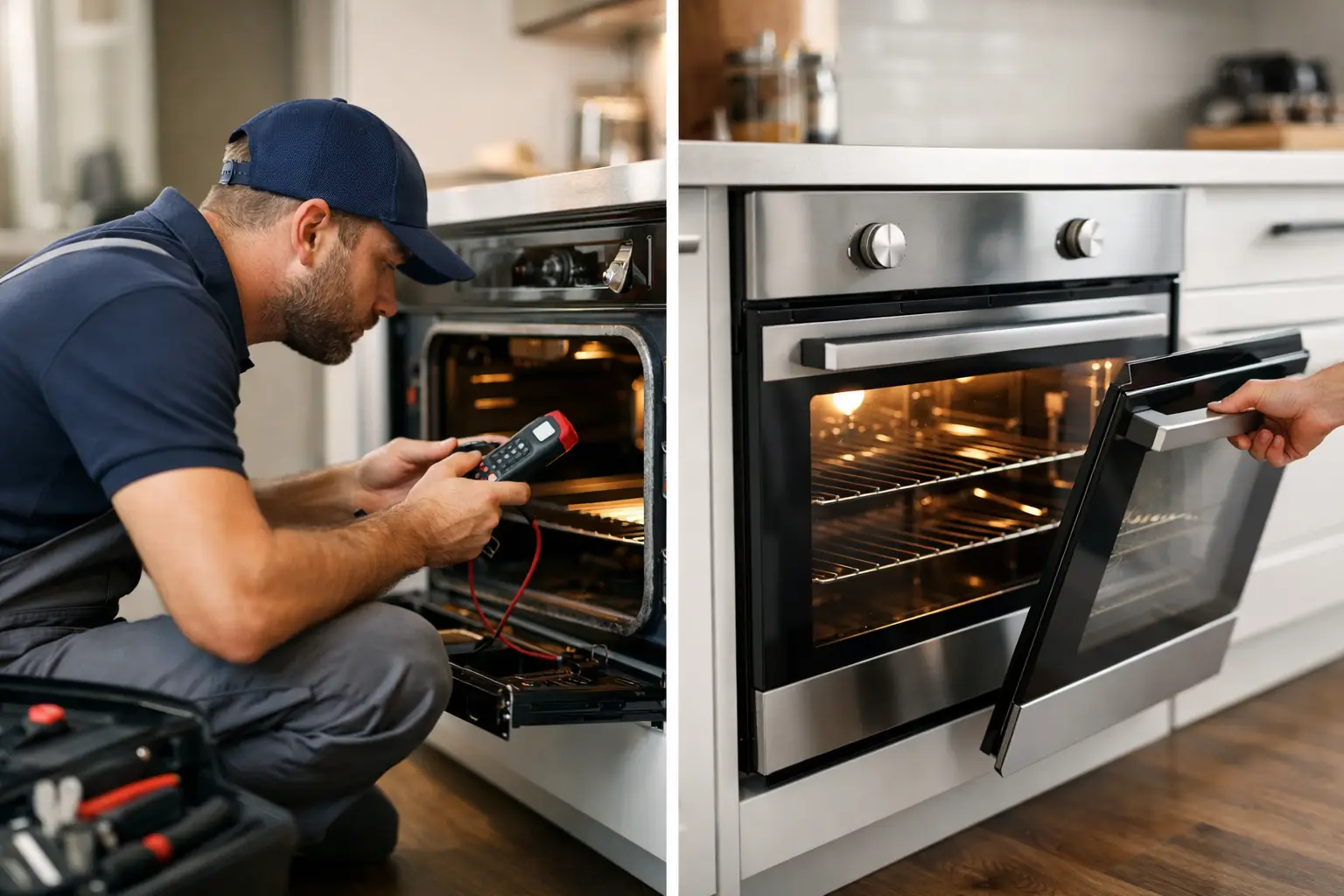
An oven usually chooses the worst possible moment to fail – just before dinner, during a tenancy changeover, or when you have a full week of work ahead and no time for disruption. If you are trying to decide whether to repair or replace oven issues, the right answer is rarely based on one thing alone. Cost matters, but so do safety, age, parts availability, energy use and how urgently you need the appliance back in service.
For most households and landlords, the sensible starting point is a proper diagnosis. A fan oven that has stopped heating might need a relatively straightforward element replacement. An oven that keeps tripping the electrics, burns food on one shelf and leaves it raw on another, or has multiple failing components is a different conversation. The decision has to be practical, not hopeful.
Repair or replace oven: start with the fault, not the guess
People often assume the worst because the oven has gone completely dead or is no longer heating evenly. In reality, some of the most common faults are repairable without replacing the whole appliance. A failed heating element, faulty thermostat, damaged door seal, worn fan motor or broken selector switch can often be put right at a sensible cost.
The trouble is that similar symptoms can point to very different faults. An oven not heating at all could be an element, a control board issue, a wiring fault or an electrical supply problem. If the appliance is integrated, the diagnosis also needs to account for safe isolation and access. That is why guessing from online forums tends to waste time and money.
Where repair often makes sense is when the fault is isolated, the appliance is otherwise in decent condition, and the parts are still available. If the oven has been reliable up to this point and the repair restores full performance, there is little benefit in rushing to replace it.
When repairing an oven is usually the better option
A repair is often the better route when the oven is under ten years old, from a reputable brand, and the repair cost is modest compared with replacement. This is especially true with built-in ovens, where replacing the unit may also mean checking cabinet fit, electrical loading and installation compatibility.
A straightforward repair can also be the better operational choice. For a busy household, one visit and one part may be far less disruptive than shopping for a new oven, waiting for delivery, arranging installation and dealing with disposal of the old unit. For landlords and property managers, fast repair can help keep a property functional without unnecessary void-period delays.
Another point that often gets missed is fault history. If this is the first major issue and the oven has otherwise performed well, repair is usually worth considering. One failed component does not automatically mean the whole appliance is at the end of its life.
When replacement is the smarter decision
There are times when replacing the oven is the more cost-effective and safer route. If the appliance is older, has recurring faults, or needs several major components at once, continued repair can turn into false economy. The same applies if spare parts are discontinued or priced so high that the repair no longer makes commercial sense.
Safety should carry real weight here. If an oven is tripping the circuit, showing signs of overheating, giving off a burning smell from internal electrical parts, or has damaged wiring, the condition needs to be assessed properly. Some faults are repairable. Some indicate wider deterioration. If confidence in the appliance is gone, replacement can be the right call.
Replacement also becomes more attractive when efficiency and reliability are poor. An older oven that runs inconsistently, takes too long to heat, and has already had several repairs may be costing you in wasted energy, wasted time and spoiled food. That is particularly relevant for rental properties and small commercial kitchens, where reliability is part of keeping the property usable.
The age rule is helpful, but not absolute
Many people want a simple age cut-off, but there is no honest one-size-fits-all answer. As a rough guide, if the oven is under eight years old and the fault is limited, repair is often worthwhile. Between eight and twelve years, it depends heavily on brand, condition and repair cost. Beyond that, replacement becomes more likely, especially if there are multiple issues.
That said, age on its own should not decide it. A well-built oven from a quality manufacturer may still be worth repairing at ten years old if the fix is straightforward. A cheaper model with repeated faults at six years old may not be.
Usage matters too. An oven in a family kitchen used every day will age differently from one in a second property used occasionally. In rental homes, wear can be harder and maintenance history less consistent. A proper assessment should always look at condition, not just the date on the rating plate.
The real question is cost versus remaining life
The simplest way to think about whether to repair or replace oven problems is this: what are you paying for, and how much reliable life are you likely to get back?
If a repair costs a reasonable amount and is likely to give you several more years of dependable use, it is often good value. If the repair is expensive and the appliance still has other ageing parts that may fail soon after, replacement is usually the better investment.
There is also the installation side to consider. A like-for-like replacement may be straightforward, but not every new oven is a direct swap. Electrical requirements, housing dimensions and circuit protection all matter. In some homes, especially older properties, the installation needs checking properly before a new unit goes in. That is one reason a combined appliance and electrical engineering service is useful – the fault, the supply and the installation can all be considered together rather than as separate problems.
Common signs your oven is worth repairing
Some symptoms strongly suggest a repair is worth pricing before you think about replacement. If the oven light works but there is no heat, a heating element or thermostat fault is possible. If the grill works but the main oven does not, that again can point to a specific failed component rather than total appliance failure. Uneven cooking, a fan that has become noisy, or a door that no longer seals properly are also faults that can often be corrected.
These are not guarantees, and safe testing matters, but they are signs that the problem may be repair-led rather than replacement-led.
Signs replacement may save you money and hassle
If the oven has become unreliable in several ways at once, replacement should move up the list. Examples include inconsistent temperature control combined with electrical tripping, visible control panel failure, corrosion inside critical areas, or repeated breakdowns over a short period.
Another warning sign is when a previous repair has only bought a short period of improvement. If one fault follows another, the appliance is telling you something. At that stage, spending more can feel cheaper in the moment but cost more over the next year.
For landlords, there is also a practical standard to think about. Even if an old oven can technically be repaired again, a replacement may be the better management decision if it reduces call-backs, improves tenant satisfaction and gives you a clearer maintenance cycle.
Why a proper diagnosis matters before you choose
The biggest mistake is replacing an oven before confirming the actual fault. We see cases where the appliance is blamed, but the issue is the cooker connection unit, an isolation switch, damaged wiring, or another electrical fault affecting performance. The reverse is also true – customers sometimes spend on repeated small fixes when the oven itself is no longer a sensible candidate for repair.
A good diagnosis gives you a clear basis for decision-making. You need to know what has failed, whether the appliance is safe, what the repair is likely to cost, whether parts are available, and whether there are signs of wider deterioration. From there, the choice becomes far easier and far less stressful.
For London homes, where time, access and disruption all matter, that clarity is valuable. FaultFree Engineering Group approaches oven faults this way – test first, diagnose properly, explain the options clearly, and recommend the route that makes practical sense rather than simply the most expensive one.
So, should you repair or replace oven faults?
If the oven is relatively modern, the fault is isolated and the repair cost is proportionate, repair is often the right answer. If the appliance is ageing, unreliable, unsafe or heading into repeated part failures, replacement is usually the smarter move.
The honest answer is that it depends – not on guesswork, but on condition, safety, cost and expected remaining life. A quick decision made under pressure often becomes the wrong one. A tested diagnosis gives you the right one.
If your oven has stopped working, do not focus only on whether it still turns on. Focus on whether it can be restored safely, economically and with confidence. That is the point where a repair is worth doing – and the point where a replacement is worth making.