
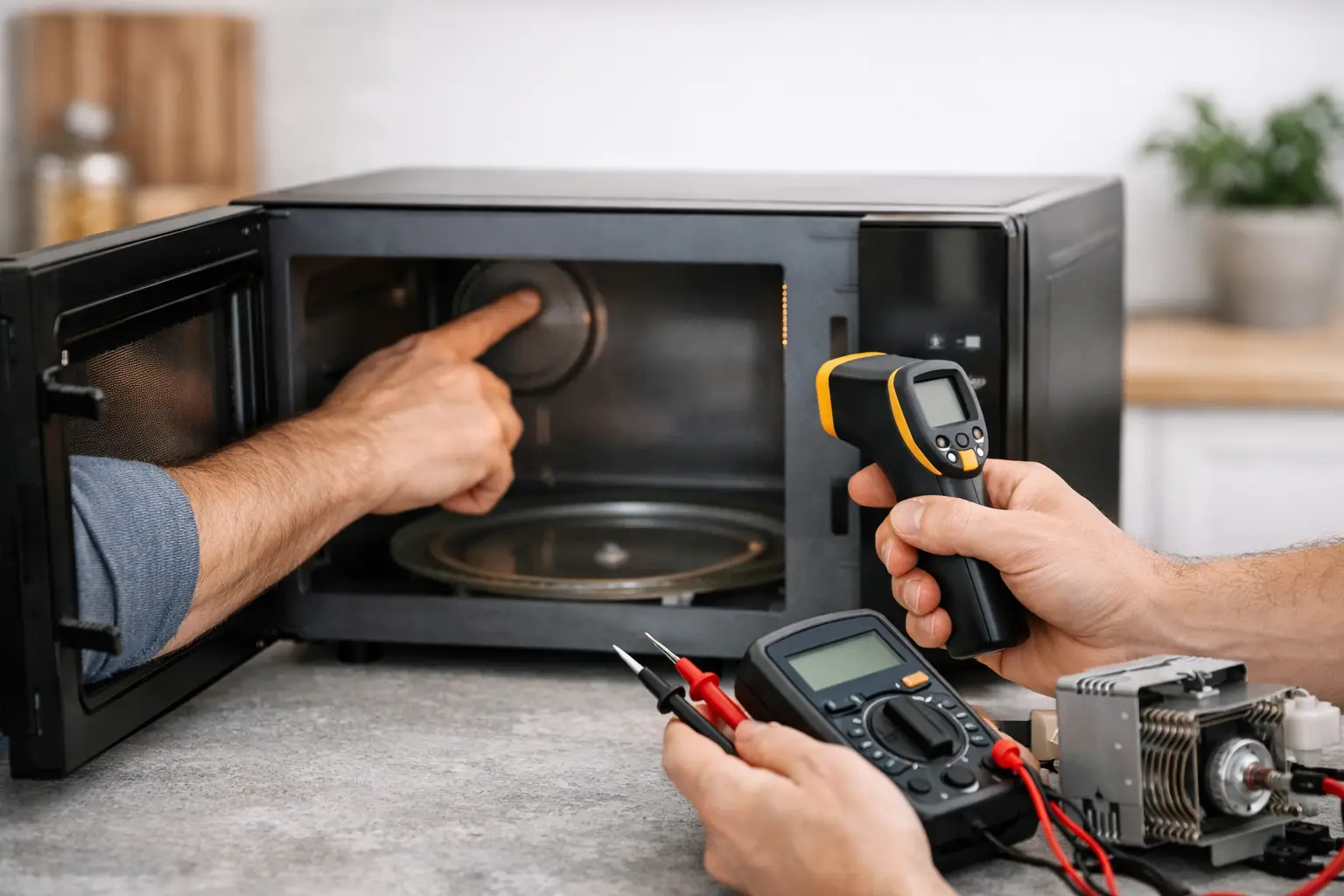
You press start, the light comes on, the turntable moves, the timer counts down – and your food comes out cold. If you are wondering why microwave stops heating, that pattern tells you something useful straight away. Power is reaching parts of the appliance, but the component that actually generates heat is not doing its job.
That matters because a microwave is not like a kettle or toaster where a simple heating element is often the issue. Microwaves use high-voltage parts that can remain dangerous even when unplugged. So while there are a few basic checks you can make at home, there is a clear line between sensible troubleshooting and a repair that should only be carried out by a qualified engineer.
Why microwave stops heating even though it still runs
When a microwave appears normal but does not warm food, the fault is usually in the high-voltage circuit. In plain terms, the appliance still has enough power to run the display, fan, light and turntable, but not enough to produce microwaves that heat the food.
The most common causes include a failed magnetron, a faulty high-voltage diode, a defective capacitor or transformer, or a door switch problem that stops the heating cycle from engaging properly. In some models, a damaged control board can also interrupt heating while leaving everything else seemingly operational.
The exact fault depends on age, brand, usage and what happened just before the problem started. A microwave that suddenly stopped heating after making a loud pop points in a different direction from one that has been heating weakly for weeks.
Start with the simple checks
Before assuming the worst, rule out the obvious. It sounds basic, but it saves time and unnecessary repair costs.
First, make sure the appliance is not set to a low power mode. Some microwaves can be switched to reduced power for defrosting or gentle reheating, and that can be mistaken for a fault. Next, test it with a mug of water for one minute rather than relying on how food feels. Different foods heat unevenly, but water gives a clearer result.
Then check the door. If it does not close cleanly, if the latch feels loose, or if you have to push it firmly before the microwave starts, the door interlock switches may not be engaging properly. A door switch fault is one of the more common reasons a microwave runs without heating.
Also look inside the cavity. Burn marks, a damaged waveguide cover, heavy grease build-up or signs of arcing can all interfere with performance. If the microwave has been sparking, stop using it until it has been inspected.
The most likely faults behind a no-heat microwave
Magnetron failure
The magnetron is the part that generates the microwaves used for heating. If it fails, the microwave may still look fully alive but produce no heat at all. In some cases, you may have heard a buzzing noise, smelt something electrical, or noticed heating becoming inconsistent before total failure.
Magnetrons can fail due to age, overheating, poor ventilation or repeated operation when empty. Running a microwave with no food or liquid inside can damage internal components because there is nothing to absorb the energy being produced.
A failed magnetron is repairable in many cases, but whether it is worth doing depends on the make, model and overall age of the appliance. On a premium built-in unit, replacement is often sensible. On an older budget countertop model, replacement of the whole appliance may be more practical.
High-voltage diode or capacitor fault
The diode and capacitor work with the transformer to deliver the voltage needed for heating. If either of these parts fails, the microwave may run but not heat, or it may heat only weakly.
These components are not suitable for DIY testing unless you are properly trained. Even after the microwave is unplugged, the capacitor can hold a dangerous charge. That is why this type of fault should be treated as an engineering job, not a home repair.
Door switch problems
Microwave door switches are safety components. They tell the appliance the door is shut and safe to operate. If one switch fails or becomes misaligned, the microwave may start but not energise the heating circuit.
This issue sometimes shows up as intermittent heating. One day the appliance works, the next day it does not, or it only heats if the door is opened and shut again. Because these faults can worsen with use, they should be dealt with promptly.
Control board fault
If the control board is not sending power correctly, the heating system may not activate. This is less common than a magnetron or door switch issue, but it does happen, especially in older appliances or after a power surge.
Control board faults can be awkward because they may mimic other issues. Proper diagnosis matters here. Replacing parts by guesswork often turns a straightforward repair into an expensive one.
Why microwave stops heating after sparking
If you are specifically asking why microwave stops heating after sparks, there are a few possibilities. The spark itself may have come from metal being placed inside, from food splatter carbonising on the interior, from a damaged waveguide cover, or from a component starting to fail.
If the sparking was brief and caused by something obvious like foil, the internal heating components may still be fine. If the microwave now runs but does not heat, the event may have damaged the magnetron, diode or waveguide area. Burnt marks inside the cavity should not be ignored. They can lead to repeat arcing and further damage.
Cleaning minor food residue is one thing. Repairing a burnt internal panel or replacing damaged high-voltage parts is another. If there is visible damage, the safe approach is to stop using the appliance until it has been tested.
Built-in microwaves need a bit more thought
With built-in models, poor ventilation is a regular contributor to overheating and shortened component life. If the unit has been installed too tightly, or vents are blocked by cabinetry or grease build-up, heat cannot escape properly.
This does not always cause an immediate failure. More often, it shortens the life of the magnetron and surrounding components over time. For landlords and property managers, that distinction matters. A repeat failure in a built-in microwave may not only be an appliance issue – it may be an installation or ventilation issue as well.
That is one reason many customers prefer an engineering team that can look at both the appliance and the electrical or installation side if needed.
What you can safely do yourself
You can check the settings, test with water, inspect the door for obvious misalignment, clean the interior, and make sure the vents are not blocked. You can also confirm the socket is working properly by testing another appliance, although if the microwave powers on, the socket is unlikely to be the main issue.
You should not remove the outer casing to investigate further. Microwaves are not forgiving appliances to work on without the right knowledge and equipment. The risk is not just poor repair quality. It is personal safety.
When repair is worth it – and when it is not
A good repair depends on the appliance value, the fault, and the availability of parts. If the microwave is a higher-end integrated model from a major brand, repair is often cost-effective. If it is a low-cost freestanding unit with a failed magnetron, replacement may make more sense.
There is also the question of reliability. If one major component has failed but the appliance is otherwise in good condition, a repair can give you years more service. If the unit is old, corroded, noisy and already has a damaged door or interior, spending money on it may not be the best decision.
An honest diagnosis should take all of that into account. The right answer is not always repair at any cost.
Signs you should book an engineer promptly
If the microwave is tripping the electrics, making a loud humming noise, sparking, smelling burnt, or heating intermittently, stop using it. Those are not wait-and-see faults. They can point to a failing high-voltage component or a safety issue with the door system.
The same applies if the appliance is in a rental property or commercial setting where reliability matters. A microwave that half-works is still a fault, and delayed action usually means more disruption later.
For households and landlords across London, speed matters just as much as diagnosis. A clear assessment, transparent pricing and a proper repair decision save more time than repeated resets and guesswork.
If your microwave has power but no heat, treat it as a fault that needs proper testing, not a minor annoyance. The useful part is this: the symptoms usually narrow the issue down quite quickly, and once the right engineer has seen it, you can make a sensible call on repair versus replacement with confidence.