
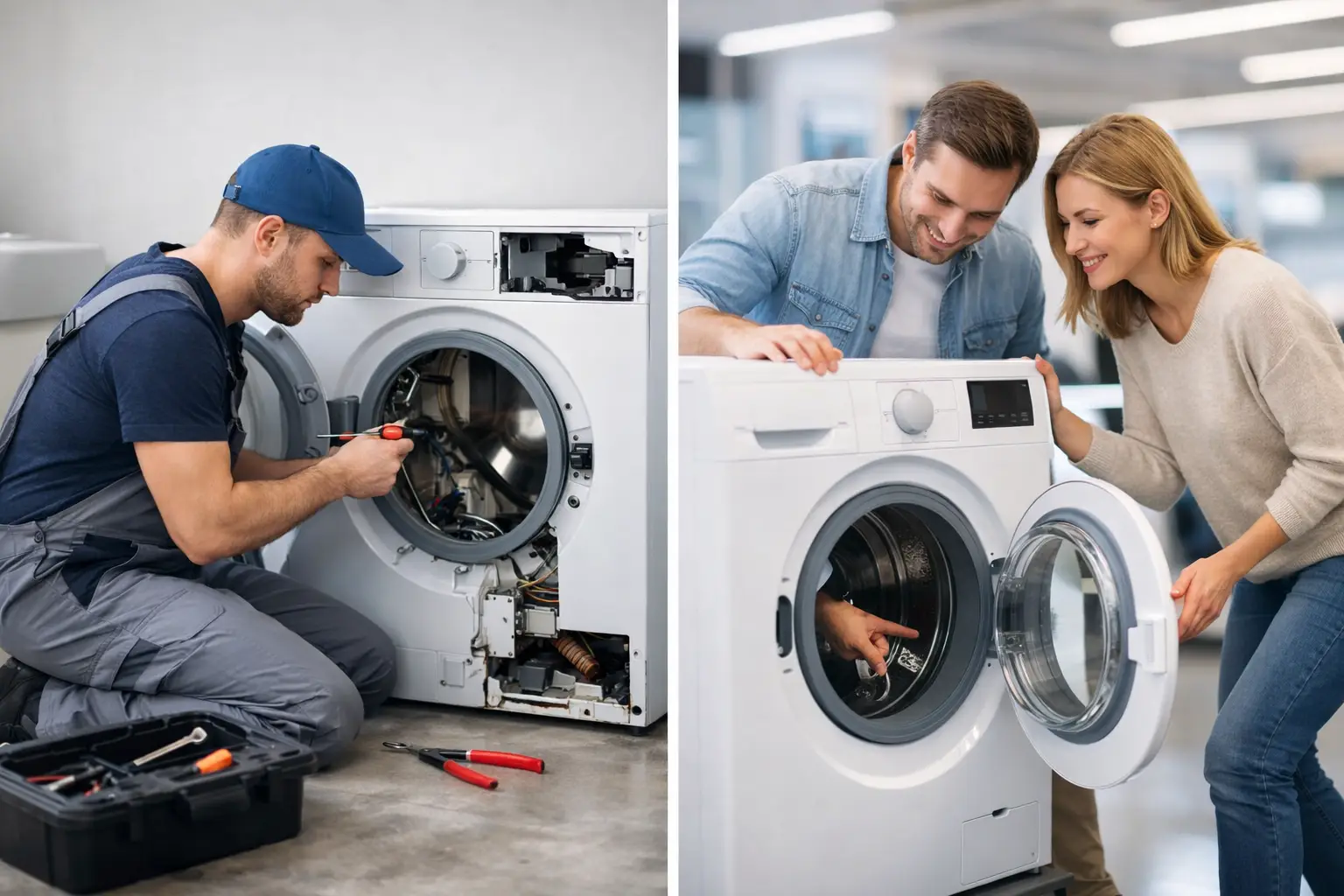
A washing machine usually picks the worst possible moment to fail – before work, between tenant changeovers, or halfway through a full family wash load. When that happens, the question is simple: should you repair or replace washing machine problems, or is it time to stop spending money on an ageing appliance?
For most London households and landlords, the right answer comes down to cost, safety, age, fault type and how quickly the machine can be returned to service. A good engineer will not push a repair that does not make financial sense, and they should not recommend replacement if a durable fix is still the better option.
How to decide: repair or replace washing machine faults
The first thing to look at is not the brand name or the original purchase price. It is the fault itself. Some issues are relatively minor and economical to fix, while others point to wider wear inside the machine.
If the washing machine is not draining, not spinning, leaking from a hose, refusing to lock, tripping the electrics, or showing an error code, that does not automatically mean replacement. Many of these faults can be traced to a failed pump, worn door interlock, damaged seal, faulty heating element, blocked filter system or control issue. These are common repair jobs, and when diagnosed properly they often offer good value.
On the other hand, if the drum bearings have failed, the motor is severely worn, the control board has suffered extensive damage, or the outer drum is compromised, the repair can become expensive very quickly. At that stage, the sensible decision depends on the machine’s age and overall condition.
The age of the appliance matters, but not on its own
A lot of people follow a rough rule that if a machine is over seven or eight years old, it should be replaced. That is too simplistic. Some premium machines from brands such as Miele, Bosch, AEG and LG can still be worth repairing beyond that point if the fault is isolated and the rest of the appliance is sound.
By contrast, a lower-cost machine that is only five years old may not be worth a major repair if it has already had repeated issues, excessive rust, poor spin performance and signs of electrical wear. Age matters because components wear together over time, but it should never be the only factor.
What matters more is the relationship between the repair cost and the likely remaining service life. If a quality repair gives you several more years of reliable use, that is often better value than replacing the appliance early. If the machine is at the end of its working life and one repair is likely to be followed by another, replacement starts to make more sense.
When repair is usually the smarter choice
Repair is often the right option when the machine is under ten years old, the fault is clearly diagnosed, the drum and motor are in reasonable condition, and the repair cost is well below the price of a comparable replacement.
This is especially true where the issue is limited to one serviceable part. A failed pump, heater, pressure switch, door lock, belt, inlet valve or seal can often be replaced without turning the job into a major rebuild. The key is accurate diagnosis. Replacing parts by guesswork wastes time and money.
For landlords and property managers, repair can also be the better operational decision when speed matters more than shopping around for a new machine, arranging delivery and fitting, and dealing with disposal. A straightforward repair can often get a rental unit back up and running with less disruption for tenants.
There is also a practical point many people overlook. New appliances are not always built to the same standard as older, mid-to-premium models. If your existing machine has been reliable and the current fault is repairable, keeping it in service may be the more dependable option.
When replacement is the safer financial decision
Replacement becomes more attractive when the repair cost is high relative to the machine’s value, especially if the appliance is already old or showing multiple signs of decline. If one major component has failed and other parts are also worn, you may simply be delaying the next breakdown.
There are some warning signs that often point towards replacement rather than repair. Repeated callouts for different faults in a short period are one. Excessive noise from worn bearings is another. Significant rust around the cabinet, damage to the drum assembly, burning smells, recurring electrical trips, or visible signs of water reaching internal wiring should all be treated seriously.
At that point, it is not just about economics. Safety matters. A washing machine is both a water appliance and an electrical appliance. If there is evidence of electrical fault conditions, overheating, or water ingress affecting internal electrics, the machine should be properly assessed before any further use.
Cost is not just the repair bill
People often compare a repair quote with the shelf price of a new washing machine and stop there. That does not give a full picture.
A replacement machine also comes with delivery lead times, installation costs if needed, disposal of the old appliance, potential alterations to plumbing or connection points, and time lost waiting for the whole process to be completed. In a busy household or rental property, the hidden cost of downtime can be just as frustrating as the invoice.
That said, repair should still be judged honestly. If the cost of putting the machine right is approaching half or more of the price of a good quality replacement, the numbers need careful thought. This is where transparent pricing matters. You need a clear diagnosis and a realistic view of what that repair is expected to achieve.
Repair or replace washing machine issues by fault type
Some faults sit firmly in the repair category. Machines that do not fill properly, fail to heat water, stop mid-cycle, display a door error, or leave clothes too wet after spinning often have identifiable component failures that can be rectified.
Leaks need a bit more care in the decision-making. A split hose, worn door seal or loose connection is normally repairable. A leak linked to a cracked drum, failed bearing seal or serious internal corrosion is a different matter.
Electrical faults also vary. A machine tripping the consumer unit could be something as straightforward as a failed heating element to earth, but it could also indicate a wider insulation fault or moisture affecting several components. This is where appliance engineering and electrical knowledge need to work together. A proper test matters more than assumptions.
Why a proper diagnosis saves money
The biggest mistake customers make is replacing a washing machine too early because the symptoms look dramatic. The second biggest mistake is paying for repeated small fixes on a machine that is already past sensible repair.
Both problems come from poor diagnosis.
A dependable engineer should be able to tell you what has failed, whether that fault is isolated or part of broader wear, what the repair is likely to cost, and whether the machine is still worth investing in. That advice needs to be honest, not sales-led. If replacement is the better option, you should be told clearly. If repair is worthwhile, you should know why.
This is particularly important in London, where time, access and disruption all matter. Working adults, tenants and landlords do not want vague answers. They want the fastest route to a safe, reliable result.
The landlord and tenant angle
If you manage rental property, the decision often has less to do with sentiment and more to do with reliability between tenancies. An appliance that breaks down repeatedly creates complaints, delays and avoidable callouts.
In many cases, a well-executed repair is the most efficient route because it restores service quickly and avoids the lead time of sourcing and installing a new machine. But if the appliance has become a recurring issue, replacement can reduce future maintenance pressure and give tenants a more dependable setup.
What matters is making the decision before the situation becomes urgent again. If a machine is already showing signs of decline, waiting for the next failure rarely improves the economics.
The best question to ask before you spend
Instead of asking only, “How much is the repair?”, ask, “What am I likely to get from this repair?”
If the answer is a safe, durable fix with a strong chance of several more years of service, repair is often the right call. If the answer is a costly job on a machine with limited life left, replacement is usually the wiser investment.
At FaultFree Engineering Group, that is the standard any customer should expect – straight advice, transparent pricing and a repair recommendation only when it genuinely stacks up. A washing machine does not have to be brand new to be worth saving, but it does have to be safe, economical and dependable enough to justify the spend.
If your machine has started leaking, tripping power, refusing to spin or stopping mid-cycle, do not guess. Get it properly assessed, weigh the numbers honestly, and make the choice that gives you the least disruption and the most reliable outcome.