
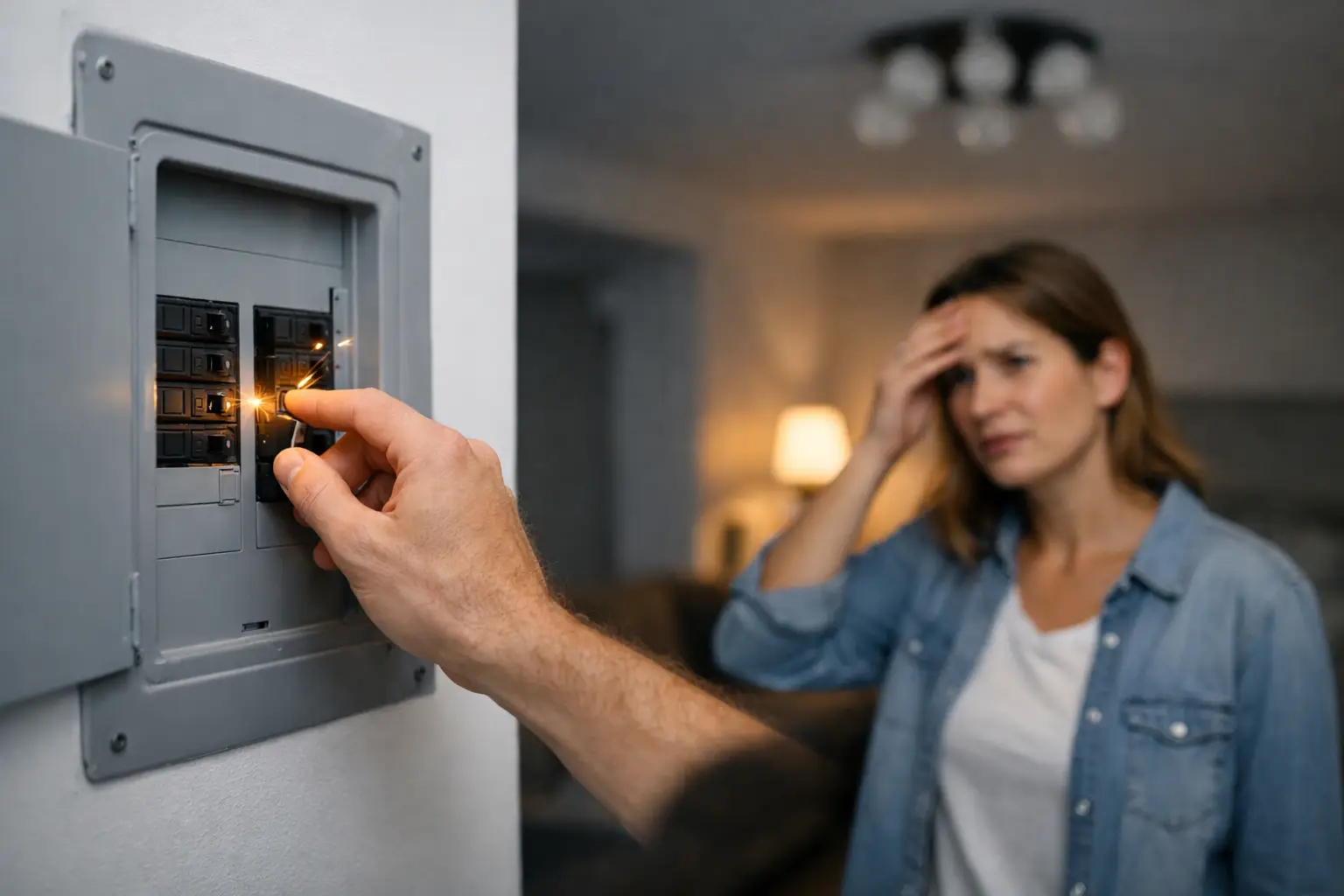
You switch on a light, and suddenly part of the property goes dark. Or the breaker only trips when the kitchen spots, bathroom light or outside fitting is in use. If you are asking why lights keep tripping, the key point is this: the trip is usually doing its job. It is cutting power because something on that circuit is unsafe, overloaded or leaking current.
That does not automatically mean a major rewire is needed. In many London homes, the fault is far more localised – a damaged fitting, moisture in an outside light, a tired transformer, poor connections, or a fault on the circuit itself. The right fix depends on what is actually causing the protective device to operate.
Why lights keep tripping – what the consumer unit is telling you
Your consumer unit is designed to shut a circuit down when it detects a problem. That problem might be too much current on the circuit, a short circuit, or earth leakage. The detail matters, because the type of trip often points to a different kind of fault.
If a single lighting breaker trips the moment a switch is turned on, that often suggests a fault on that lighting circuit or within a particular fitting. If an RCD trips instead, the issue may involve current leaking to earth. That can happen with water ingress, damaged insulation, or faulty electrical accessories. If the main switch or a wider section of the board trips, the fault may be affecting more than one part of the installation.
This is why guessing rarely saves time. Repeated resetting without proper fault finding can make the issue harder to trace, and in some cases more dangerous.
The most common reasons lights trip the electrics
In domestic and small commercial properties, lighting trips usually come down to a handful of common faults.
A faulty light fitting is high on the list. Ceiling roses, pendants, downlights, bathroom fittings and outside lanterns all wear out over time. Heat, vibration and age can damage internal components, especially where cheaper fittings have been installed or lamps of the wrong type have been used.
Moisture is another regular cause. Bathroom lights, soffit lights, porch lights and garden fittings are exposed to steam, condensation and weather. Once moisture gets inside, insulation resistance can drop and the RCD reacts exactly as it should.
Damaged wiring is also common, particularly in older properties and rental homes with a long repair history. A screw through a cable, crushed insulation in a loft, or deteriorated cable sheathing behind a fitting can all cause intermittent trips that seem random until the circuit is properly tested.
Then there is the issue of accessories on the same circuit. A lighting circuit may include extractor fans, transformers, dimmer switches, smart controls or emergency lighting packs. The fault is not always the lamp itself. Sometimes the trip only appears to be linked to the light because that is the part you can see.
When the problem is the bulb, and when it is not
Sometimes the cause is simple. A failed bulb can trip a breaker, especially older halogen lamps or poor-quality LED lamps with internal driver faults. If the trip started immediately after one lamp failed, replacing that lamp with the correct type may resolve it.
That said, it is not wise to assume the bulb is always to blame. If a new lamp trips the circuit as well, or if more than one fitting is affected, the issue is likely elsewhere. Repeated lamp failures in the same fitting can also point to overheating, poor contact at the lampholder, or a voltage-related issue that needs testing.
A dimmer switch can complicate matters. Not all LED lamps are dimmable, and not all older dimmers are compatible with newer LED loads. The result may be flickering, buzzing, poor performance or nuisance tripping.
Why lights keep tripping in one room only
If the issue happens only in a bathroom, kitchen, loft conversion or outside area, that narrows the search.
Bathrooms often develop faults because of humidity and incorrect fittings used in the wrong zone. Kitchen lighting can be affected by steam, grease build-up, or under-cabinet accessories that have started to fail. Loft conversions sometimes have hidden junction boxes or inaccessible connections that were installed during previous works and are now deteriorating. Outside circuits are especially vulnerable because weather exposure speeds up wear.
Where one room keeps causing the trip, an engineer will usually isolate fittings and test the circuit in sections. That is a faster and safer route than replacing parts one by one and hoping the problem disappears.
Older properties and recurring lighting faults
A lot of London housing stock is older, and that changes the diagnosis. In period homes and converted flats, lighting circuits may have seen years of alterations – extra fittings added, old cables jointed into newer sections, accessories changed several times, and little consistency in how the work was done.
That does not always mean the whole installation is unsafe, but it does mean faults can be layered. A trip may start after a new fitting is installed, while the underlying weakness has actually been sitting in the circuit for years.
This is one reason recurring electrical faults should be treated properly rather than patched. Replacing a visible fitting may restore power, but if poor connections or ageing insulation are present elsewhere, the problem can return without much warning.
What you can check before calling an electrician
There are a few sensible checks you can make without removing covers or touching fixed wiring. Note whether the trip happens when one specific switch is used, whether it affects only the lights, and whether it started after a lamp change, decorating work or recent water ingress. If safe to do so, turn off the suspect light switch, reset the breaker, and see whether the rest of the circuit holds.
You can also look for obvious signs such as flickering before the trip, a burnt smell near a fitting, staining around ceiling lights, or outdoor fittings with visible condensation. Those details help speed up diagnosis.
What you should not do is keep forcing the breaker back on if it will not stay on, swap wiring around, or open fittings unless you are competent to do so safely. Lighting circuits may look simple, but fault conditions are not always obvious and can present a shock or fire risk.
When a tripping light is an urgent safety issue
Some situations should be treated as urgent. If the breaker trips with a bang, you notice burning smells, discolouration around a switch, signs of water entering a fitting, or the circuit will not reset even with all lights switched off, stop using that part of the installation.
The same applies if the problem is affecting communal areas, escape routes, rental properties between tenancies, or business premises where safe lighting is part of day-to-day operation. A nuisance trip is inconvenient at home. In a tenanted or commercial setting, it can quickly become a safety and compliance problem as well.
How an engineer usually finds the fault
Proper electrical fault finding is about testing, not guesswork. A qualified engineer will identify which protective device is tripping, inspect the affected circuit, isolate likely accessories and carry out tests such as insulation resistance, continuity and polarity checks where appropriate.
From there, the repair might be straightforward – replacing a failed fitting, resolving a damaged connection, correcting an outside light with water ingress, or separating a faulty accessory from the circuit. In other cases, a wider issue is uncovered, such as degraded wiring or previous poor workmanship.
That is where using a service that understands both electrical systems and connected appliances can save time. In some homes, what looks like a lighting fault turns out to involve an extractor, cooker hood, fan isolator or another fixed electrical item sharing the same problem path.
Repair or replace?
It depends on the age of the installation, the location of the fault and the overall condition of the circuit. If the issue is limited to one accessory or fitting, repair is often the practical option. If testing shows broader deterioration, repeated jointing, or poor reliability across the circuit, replacement may be the better long-term decision.
For landlords and property managers, this matters because the cheapest immediate fix is not always the most cost-effective once repeat call-outs, tenant disruption and compliance concerns are considered. Transparent advice matters here. A sound engineer should explain whether a local repair is enough or whether the circuit needs more substantial work.
At FaultFree Engineering Group Ltd, that is the approach – identify the actual fault, make the safe repair, and only recommend wider works when the condition of the installation genuinely calls for it.
If your lights keep tripping, treat it as a warning rather than a nuisance. Electrical systems rarely fail without giving signs first, and a fast, accurate diagnosis usually prevents a smaller fault turning into a larger one.